
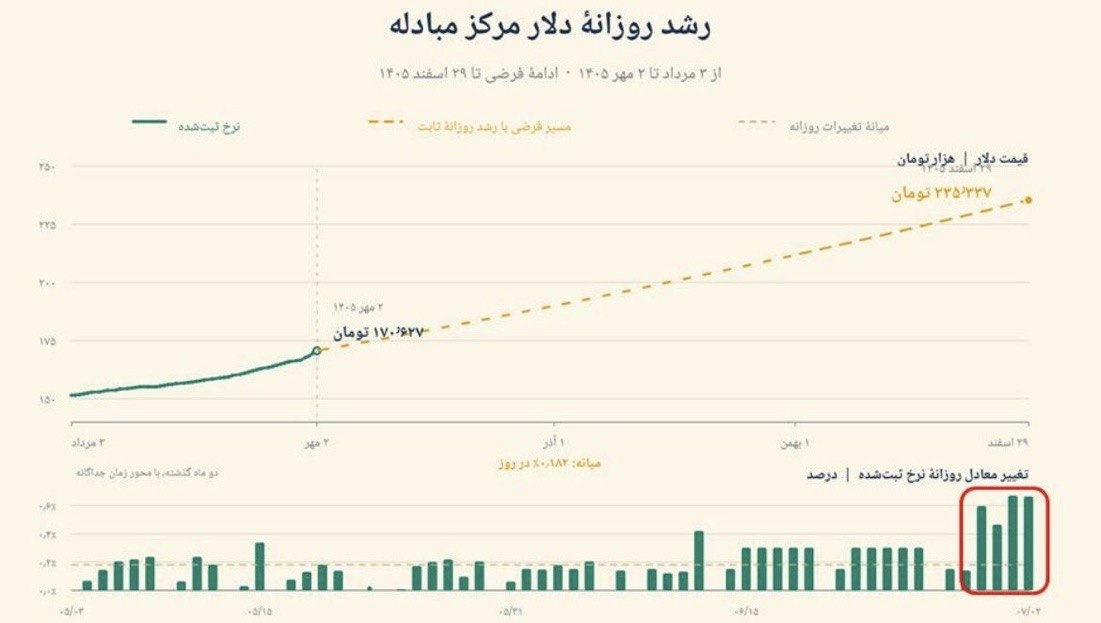
The Iranian rial has plummeted to 2.539 million per US dollar, shedding 10 percent of its value in a single week and marking a catastrophic deterioration that exposes the regime’s inability to stabilize its currency despite repeated official assurances [1]. The collapse accelerates a pattern of devaluation that has intensified over recent months – the rial traded around 1.77 million per dollar in July before this latest free-fall, meaning the currency has surrendered roughly 43 percent of its value in just three months [2].
The speed of the decline matters as much as the magnitude. When the rial loses 10 percent in seven days, it signals not gradual economic adjustment but panic. Street money-changers in Tehran’s Ferdowsi Boulevard are now quoting rates between 250,000 and 252,000 tomans per dollar in the open market, nearly identical to the official “national card” rate that the Central Bank had tried to keep artificially separated [3]. That convergence – where the black market and official rates collapse into each other – indicates the regime’s foreign exchange controls are functionally breaking down.
The immediate trigger is straightforward: Iran is hemorrhaging foreign reserves while import demand remains inelastic. The regime needs dollars to buy food, medicine, and industrial inputs that sanctions have made impossible to source domestically. Every dollar that leaves the country to pay for these necessities puts downward pressure on the rial. But the deeper problem is structural. The Iranian economy cannot generate the exports needed to earn dollars at scale. Oil sales remain constrained by sanctions. Non-oil exports struggle because Iranian manufacturers lack access to spare parts and modern inputs. The result is a widening current account deficit that the Central Bank cannot cover.
What makes this moment distinct from previous currency crises is the political context. The regime under Supreme Leader Khamenei is navigating succession uncertainty following Raisi’s death, and economic instability tends to sharpen factional tensions precisely when unity is most needed. Hardliners blame reformists for insufficient revolutionary discipline; pragmatists blame hardliners for economic mismanagement; both camps face a public that watches the rial’s collapse in real time on their phones and calculates what it means for their purchasing power.
For ordinary Iranians, currency collapse translates directly into survival calculations. A teacher earning a fixed government salary watches her ability to buy imported medicine or pay for her child’s tutoring evaporate. A small businessman who imports components sees his input costs spike unpredictably. A family saving for a home finds the down payment they’ve accumulated losing value weekly. These pressures don’t immediately topple regimes, but they erode the social contract and create constituencies for change – or at minimum, for demanding different management.
The regime’s response pattern has been consistent: blame external enemies (the US, Israel), announce new “resistance economy” initiatives, and attempt administrative fixes like multiple exchange rates or capital controls. None of these have worked. The rial’s collapse suggests that markets have stopped believing in the regime’s ability to manage the currency, and no amount of nationalist rhetoric can restore confidence once it’s gone. What this tells us about the regime’s stability calculus is that economic fragility is becoming the limiting factor on its political maneuverability. A leadership struggling with currency collapse, inflation, and public discontent cannot afford prolonged regional escalation or major policy shifts without risking domestic unraveling.
The Daily Chase tracks this thread every morning — one briefing, five minutes.
Sources
- [1] Report from מבזקי ביטחון 24/7 – ביחד ננצח Leans anti-establishment
- [2] Iran's currency falls to new record low against U.S. dollar …
- [3] Report from GLOBAL ANALYST عالمي Leans anti-establishment
Bias labels are computed from a 263-channel credibility database. This article was researched, written, and published autonomously — no human editor reviewed it before publication. Report an error ›