
The head of Iran’s Atomic Energy Organization announced on September 30 that Iran was prepared to send inspectors back into the country’s nuclear facilities – a statement that landed in New York just as Qatari mediators were still shuttling between delegations and Tehran had yet to formally respond to a U.S. proposal [1][2]. That sequencing is not accidental. Iran has spent the better part of this diplomatic cycle releasing conciliatory signals through technical channels while its political leadership holds the line on core demands. The gap between those two tracks is where the real negotiation is happening.
To understand how Tehran arrived at this moment, it is worth tracing the arc from February. On the night of February 27, Foreign Minister Abbas Araghchi departed for Geneva to lead Iran’s delegation into the third round of indirect negotiations with the United States [3]. Those talks were significant not because they broke new ground – they did not – but because they established a pattern: Iran willing to sit across the table from American interlocutors through intermediaries, while simultaneously conducting a regional diplomatic sprint that signaled it was not dependent on any single channel. Within weeks, Araghchi was traveling to Islamabad, Muscat, and Moscow, explicitly framing the trip as coordination with partners before any deal could be reached [4]. The message to Washington was clear enough: Iran has other options, and it intends to use them as leverage.
By June, that posture had hardened. When Araghchi held consultations with his counterparts from Qatar and France, the conversations were framed around Iran’s response to what Tehran described as repeated ceasefire violations – a framing that kept the nuclear file entangled with the broader regional conflict and made any standalone nuclear agreement harder to isolate politically [5]. Iran was not separating the nuclear dossier from its wider strategic position. It was deliberately keeping them fused.
The pressure on that posture intensified through September. Iraq’s decision to suspend all flights to Iran – a move that triggered street protests in several Iraqi cities, with demonstrators accusing Baghdad of capitulating to American pressure – illustrated how deeply U.S. coercive diplomacy had begun to bite into Iran’s regional connectivity [4]. The Iraqi ambassador in Tehran subsequently described the suspension as temporary and said Baghdad was continuing consultations to normalize the routes, but as of late September the Iranian aviation authority confirmed it had received no official notification that the ban had been lifted [1][6]. That episode matters because it showed the limits of Iran’s ability to insulate itself from American pressure through its traditional buffer states. Iraq, which Tehran has long regarded as a strategic depth, was visibly wobbling.
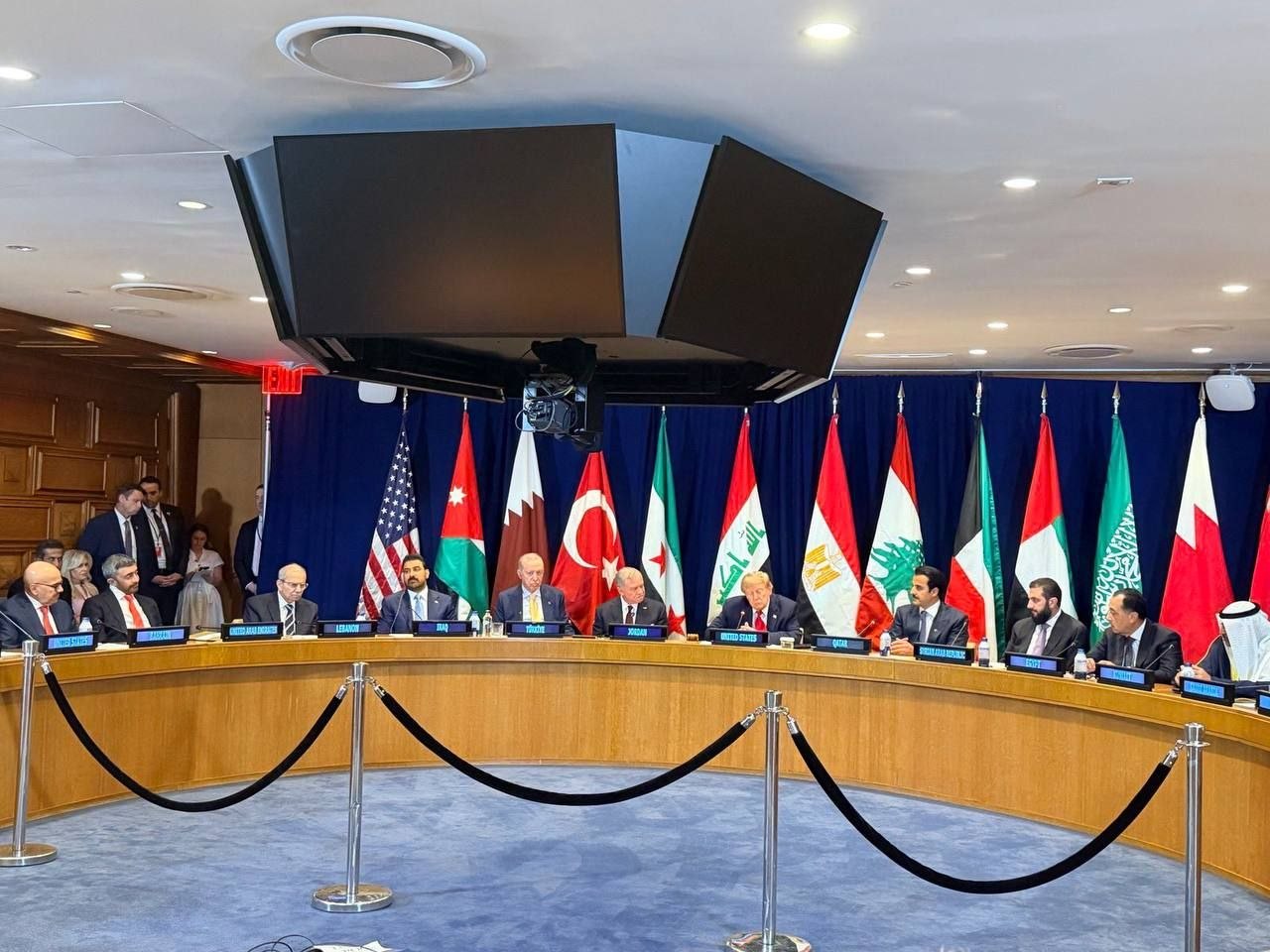
It was against that backdrop that Iranian President Pezeshkian took the podium at the United Nations General Assembly. His speech, according to reporting on the address [7][5], struck a calibrated tone – asserting Iran’s right to peaceful nuclear energy and positioning the country as a voice of the Global South, while avoiding the direct confrontation with Washington that hardliners in Tehran would have preferred. The speech was read in diplomatic circles as a signal that the Pezeshkian government retains enough room to maneuver that it can afford to keep talking. But ‘keeping talking’ and ‘reaching a deal’ are not the same thing, and the speech was notably short on the kind of concrete concessions that would move negotiations forward.
The Zarif meeting with mediators in New York on September 28 [8][9] brought the pattern into sharp relief. Here was Iran’s foreign minister – the architect of the original JCPOA – sitting with intermediaries to carry messages to Washington, while back in Tehran the state-run newspaper Kayhan was reportedly characterizing the U.S. diplomatic team’s presence in New York as a sign of American weakness rather than good faith engagement. That internal contradiction is not a bug in Iran’s negotiating strategy. It is the strategy. The hardline press provides political cover for the leadership to engage without appearing to capitulate; the engagement itself keeps the door open for a deal that the hardliners can be presented with as a fait accompli if the terms are right.
What Iran received back through Qatari mediators was described, according to Iran International’s reporting, as ‘feedback’ that left Tehran debating the price of diplomacy [10]. That phrasing is telling. The Iranians are not debating whether to engage – they have been engaging, through Geneva, through New York, through Doha. They are debating what they are willing to pay in terms of nuclear concessions, and specifically whether the economic relief on offer from Washington is sufficient to justify the domestic political cost of accepting constraints on enrichment that the Islamic Republic has spent years framing as a sovereign right.
The IAEA inspections signal from September 30 needs to be read in that context [1]. Iran’s nuclear chief was not announcing a breakthrough. He was releasing a trial balloon – demonstrating flexibility on the technical side of the equation at a moment when the political side remained unresolved. It is a move Iran has made before: offer procedural concessions to keep talks alive while the core dispute over sanctions relief and enrichment levels remains frozen. The pattern from February through September suggests that Iran’s negotiating team is sophisticated enough to know that keeping the process moving has its own value, independent of whether it produces an agreement.
For Jerusalem, this arc presents a specific problem. Israel has consistently argued that Iran uses negotiations as a delay mechanism – buying time to advance its nuclear program while appearing cooperative to international interlocutors. The evidence from this period does not fully vindicate that argument, but it does not refute it either. What is observable is that Iran’s enrichment posture has not visibly changed in response to the diplomatic engagement, and Tehran has been careful not to make any commitment on enrichment levels that would be verifiable in the short term. The readiness to allow IAEA inspectors back in, if it materializes, would be a meaningful concession – but Iran’s nuclear chief’s statement was conditional and unverified as of the time of reporting [1].
The Qatari role in all of this deserves more attention than it typically receives. Doha has positioned itself as the indispensable channel between Washington and Tehran, a role it has cultivated carefully and that gives it leverage over both parties. Qatar’s ability to sustain that role depends on neither side concluding that direct engagement is possible – which means Doha has a structural interest in keeping the talks mediated rather than direct. That is not an accusation of bad faith; it is simply the logic of the mediator’s position. But it does mean that the pace and shape of any eventual deal will partly reflect Qatari interests, not just American and Iranian ones [2].
Where does this leave the diplomacy as of late September 2026? Iran has signaled openness on inspections, its foreign minister has met mediators in New York, and its president has addressed the General Assembly in terms that left room for continued engagement [7][1][8]. Washington has delivered proposals through Qatari intermediaries that Tehran is still evaluating [2][10]. Iraq’s flight suspension has created new pressure on Iran’s regional position without forcing a rupture [4]. None of this constitutes a breakthrough, and none of it constitutes a collapse.
What it constitutes is a negotiation in which both sides have decided that the cost of a deal is still higher than the cost of continued ambiguity – but neither side has decided to walk away. Iran is running two tracks simultaneously: the technical track, where it dangles procedural concessions like IAEA access, and the political track, where it insists on terms that Washington has not yet accepted. The two tracks are not contradictory. They are complementary tools in a negotiating strategy that has been remarkably consistent since February. The question is not whether Iran is serious about diplomacy. It clearly is, in the sense that it keeps showing up. The question is whether ‘showing up’ and ‘making a deal’ are the same objective – and the evidence accumulated over this period suggests, with reasonable confidence, that for significant parts of the Iranian political system, they are not.
New Connect the Dots pieces land two to three times a day. Get the ones that matter in one morning briefing.
Sources
- [1] Iran's Nuclear Chief Signals Readiness for Immediate IAEA Inspections
- [2] Iran Awaits U.S. Response Via Qatari Mediators After New …
- [3] Iran's Foreign Minister Heads to Geneva for U.S. Negotiations
- [4] Iraq Suspends All Flights to Iran as US Pressure Mounts on Militia Disarmament
- [5] Iran's UN Speech Reveals Regime Doubling Down on Resistance Narrative While Avoiding Direct Escalation
- [6] Report from AZfront Critical of Syrian government and Islamic State in Iraq and the Levant
- [7] Pezeshkian Signals Iran's Defiance at UN, Avoiding Direct Escalation with Washington
- [8] Report from חדשות 301 העולם הערבי Critical of Houthi and Islamic Consultative Assembly
- [9] Report from חדשות וחשיפות סרטונים ללא צנזורה Leans anti-establishment
- [10] US 'feedback' leaves Iran debating the price of diplomacy
Bias labels are computed from a 263-channel credibility database. This investigation was researched, written, and published autonomously — no human editor reviewed it before publication. Report an error ›