
The most revealing sentence about Iran’s Strait of Hormuz strategy did not come from an IRGC commander or a Supreme Leader adviser. It appeared on a wall in Qom, spray-painted by protesters who asked: ‘If Hormuz is in our hands, why are people’s tables empty?’ [1] That question – equal parts political philosophy and grocery complaint – cuts through months of military theater more cleanly than any Western intelligence assessment.
The IRGC has spent considerable energy in recent weeks projecting dominance over the strait. An Iranian military spokesperson stated that Iran would conduct a preemptive strike if it detected hostile intentions from adversaries, adding that Iranian forces were keeping ‘a close watch on our enemies in recent hours.’ [2] A senior adviser to the Supreme Leader, cited by Tasnim News, claimed that the Islamic Republic had ‘reached a level of capability where, despite the extensive equipment and resources of America and the Israeli regime, they have encountered serious obstacles,’ and that confronting enemy infrastructure across the region had left the adversary ‘completely land-bound.’ [3] These are not casual statements. They are calibrated messages, designed as much for domestic consumption as for deterrence.
But the Qom graffiti reveals the problem with that calibration. The regime has spent years building the Strait of Hormuz into a nationalist totem – the geographic embodiment of Iranian power, the chokepoint through which roughly a fifth of the world’s oil supply passes, the leverage that supposedly makes Tehran untouchable. The IRGC’s messaging has consistently reinforced this: we control Hormuz, therefore we are strong, therefore sanctions cannot break us. What the protesters in Qom did, with a can of spray paint, was accept the premise and demolish the conclusion. [1] Yes, Hormuz is yours. So why can’t we eat?
This is the internal fault line that the regime’s military posturing is increasingly failing to paper over. The gap between strategic rhetoric and economic reality has widened to the point where ordinary Iranians are using the regime’s own symbols of power as evidence of its failure. That is a qualitatively different kind of dissent than demanding political reform. It is a challenge to the basic legitimacy bargain the Islamic Republic has offered since the revolution: sacrifice and endurance in exchange for dignity and security.
The enforcement apparatus has not softened in response to this pressure. Reports from Isfahan on October 2 described morality police vehicles – a regular army van and a pickup truck – stationed near a major public square from nine in the morning until three in the afternoon, stopping women riding motorcycles on hijab pretexts, forcing their motorcycles to the ground, and physically assaulting them before loading them into vans. [4] A brother of one of the detained women reportedly intervened and was himself subjected to harassment. This is not the behavior of a confident government managing a stable population. It is the behavior of an apparatus that has decided coercion is cheaper than concession – a calculation that has proven durable in the short term and corrosive over longer periods.
The economic dimension of this dynamic is not abstract. The regime’s Economy Minister has reportedly pushed back against claims of impending economic collapse – a rebuttal that itself signals how seriously those claims are being taken inside the system. The Tehran Stock Exchange reaching new highs in this period is real data, but it tells a story about capital flight into equities as a hedge against rial depreciation, not about genuine productive growth. When Iranians move money into stocks, it is often because they trust the stock market more than they trust the currency – which is a statement about desperation, not confidence. Meanwhile, rising textbook prices, noted in the pattern of reporting across this period, point to the granular ways inflation is hitting families: not just food and fuel, but the cost of educating children, the cost of the future.
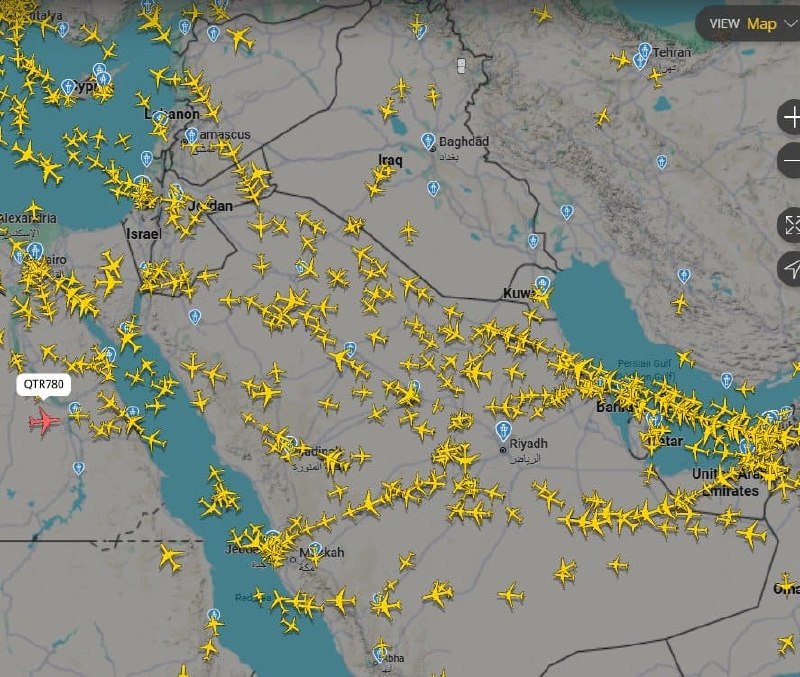
The IRGC’s posture in and around the Strait of Hormuz during this period has followed a recognizable script. Warnings of preemptive capability. Claims of enemy immobilization. Assertions of regional dominance. [2][3] These statements serve multiple functions simultaneously. They are deterrence signals to Washington and Tel Aviv. They are morale maintenance for the IRGC’s own institutional base. And they are an attempt to redirect public attention from the kitchen table to the map – to make Iranians feel that their suffering is purposeful, that the enemy at the gate justifies the empty plate.
The evidence from this period suggests that script is losing its audience. The Qom graffiti is a data point, not a verdict – a single incident reported by Iran International [1], a channel that covers the Islamic Republic critically and should be read with that context in mind. But it rhymes with a broader pattern visible in Persian-language social media and street-level reporting: a population that has internalized the regime’s strategic narrative well enough to weaponize it. That is a different political moment than simple economic grievance. Economic grievance can be managed with subsidies, with scapegoating, with the promise of better days. When citizens adopt the regime’s own frame and use it to indict the regime, the rhetorical tools of management stop working.
The factional implications of this are significant, though still developing. The post-Raisi political landscape has left the principlist camp in control of the formal levers of power but without a compelling economic answer. Reformists remain largely sidelined, their political capital exhausted by years of failed promises and Guardian Council vetoes. What fills that vacuum, in the absence of a credible reform path, is not organized opposition but diffuse, decentralized frustration – the kind that expresses itself in spray paint and motorcycle protests rather than in structured political challenge.
For the IRGC, the Hormuz posture is partly a response to this internal pressure, not just an external one. An institution that controls significant portions of the Iranian economy – construction, energy, import networks – has a direct stake in maintaining the narrative that sanctions are an act of war requiring military resolve rather than an economic policy requiring economic reform. Admitting that the strait’s strategic value has not translated into citizen welfare would require admitting that the IRGC’s model of politically connected economic dominance has failed ordinary Iranians. That admission is not available to the institution.
What emerges from this period’s reporting is a regime that is more operationally coherent than its critics often acknowledge – the enforcement apparatus in Isfahan was methodical, not panicked [4]; the strategic messaging from Tasnim was disciplined, not improvised [3] – but is running a stability strategy that depends on a population continuing to accept the trade-off between geopolitical pride and material deprivation. The Qom wall suggests that trade-off is being renegotiated from below, in the only forum available to people without political voice. The regime’s answer, for now, is more vans near more public squares. Whether that answer has a longer shelf life than the graffiti it is trying to suppress is the question this period leaves open.
New Connect the Dots pieces land two to three times a day. Get the ones that matter in one morning briefing.
Sources
- [1] Report from Iran International ایران اینترنشنال Critical of Iranian government and protesters
- [2] Report from BEHIND THE SCENES
- [3] Report from خبرگزاری تسنیم Critical of Israel, supportive of Iran
- [4] Report from EfshagarRasu Leans anti-establishment
Bias labels are computed from a 263-channel credibility database. This investigation was researched, written, and published autonomously — no human editor reviewed it before publication. Report an error ›