
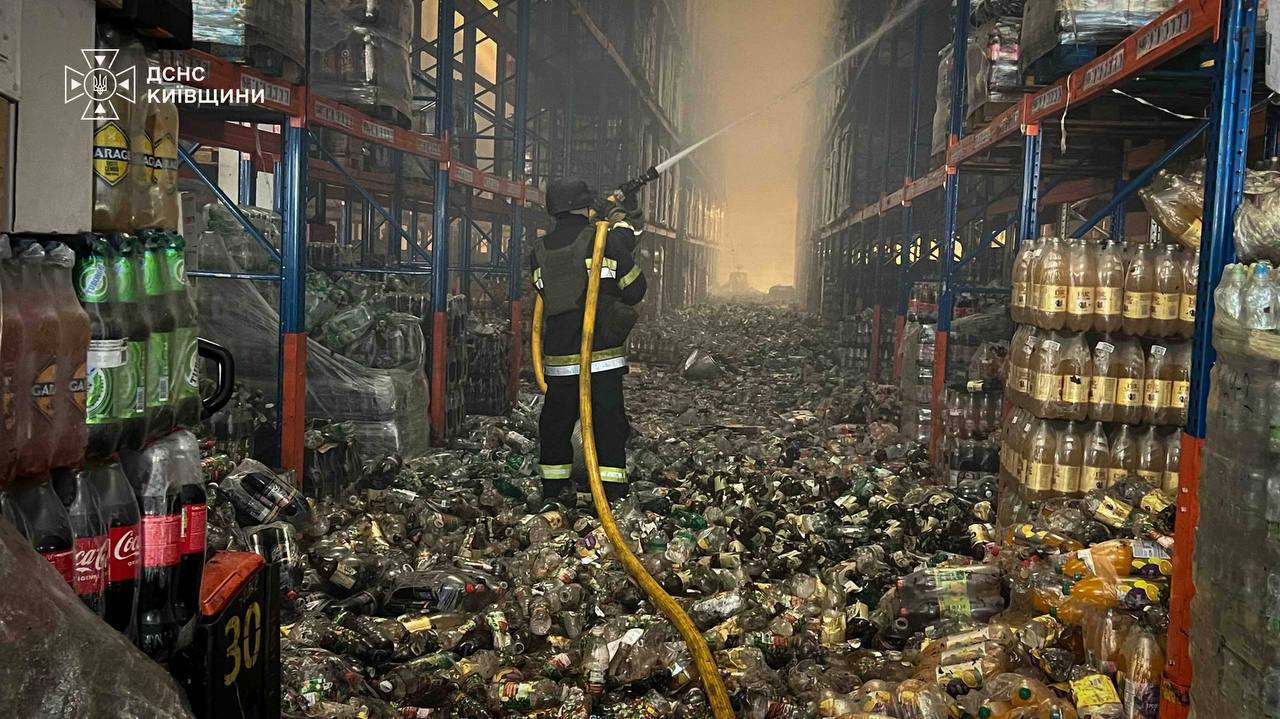
Russia has resumed concentrated strikes against food storage and distribution facilities across the Kyiv region, marking an escalation in a campaign that has systematically targeted Ukraine’s civilian supply infrastructure since the invasion began. On October 3, Russian forces struck ATB supermarket warehouses in the Brovarsky district near Kyiv, according to local reports [1][2]. The attack follows similar strikes throughout September and August against major Ukrainian retailers and food producers, including Eco Market, Silpo, and Okwine-Wine Hunters distribution centers [3][4].
The pattern reflects a deliberate Russian strategy: degrading Ukraine’s ability to sustain civilian populations in contested and government-controlled regions. By targeting logistics hubs rather than military installations, Russia creates cascading effects across supply chains without requiring precision strikes. A frozen yogurt factory in Zhytomyr was damaged twice within a single month, suggesting either repeated targeting or difficulty in establishing effective air defense coverage [1].
Ukraine’s food storage infrastructure has become a proxy battleground. According to analysis from the Center for Strategic and International Studies, Russia has destroyed approximately 90 percent of Ukraine’s modern storage facilities, a figure corroborated by Ukrainian government statements [5][6]. This destruction carries immediate humanitarian consequences – empty shelves and supply shortages in civilian markets – but also strategic weight: it undermines civilian confidence in government capacity to maintain normal life, a metric Russia monitors as an indicator of social cohesion.
The targeting pattern distinguishes between retail chains and production facilities. ATB, Silpo, and Eco Market represent the country’s largest supermarket networks, meaning damage to their warehouses creates visible shortages across hundreds of stores simultaneously. Okwine and Wine Hunters, destroyed for the second time according to the company’s statement, supplied both retail and hospitality sectors – their loss ripples beyond groceries into restaurant and bar operations, further degrading the appearance of normalcy in Ukrainian cities [4].
Ukrainian logistics companies have adapted. Eco Market reported in August that staff were working to restore distribution even as warehouses burned, and all stores remained operational despite the damage [7]. This resilience is real but finite. Each strike forces companies to rebuild inventory, divert trucks, and establish temporary distribution points – all while maintaining operations under ongoing air threat.
Russia’s targeting logic reflects a theory of victory based on attrition of civilian morale alongside military exhaustion. By making daily life visibly harder – empty shelves, price spikes, supply uncertainty – Russia aims to degrade the social cohesion that has sustained Ukrainian resistance. The strategy assumes that cumulative civilian hardship will eventually erode political support for continued defense.
What remains unclear is whether Russian targeting is becoming more precise or simply more frequent. The concentration of strikes in September and early October, after a relative lull in late August, suggests either improved intelligence on warehouse locations or a deliberate decision to intensify pressure as autumn approaches and heating season begins. Ukrainian air defense has improved since spring, but warehouse facilities lack the layered protection of military installations.
The destruction of food storage also carries agricultural implications. Ukraine’s harvest season is underway, and damaged storage capacity means perishable goods cannot be preserved for winter or export. This compounds earlier Russian strikes against grain elevators and agricultural facilities, which have destroyed Ukraine’s ability to store and export grain – historically the country’s primary export revenue source and a critical component of global food security.
Watch for: whether Ukraine can accelerate warehouse reconstruction or hardening; whether strikes expand to target fuel depots and heating infrastructure as winter approaches; and whether the visible civilian supply disruptions translate into measurable shifts in public support for continued war.
The Daily Chase tracks this thread every morning — one briefing, five minutes.
Sources
- [1] Report from INSIDER UA Critical of Russia, supportive of Third Army Corps
- [2] Report from Телеграмна служба новин – Україна Critical of China, Belarus, and Russia
- [3] Report from Лачен пише Leans anti-establishment
- [4] Report from Київ Times Opposition-aligned
- [5] Russia has destroyed 90% of Ukraine's modern storage …
- [6] Spotlight on Damage to Ukraine's Agricultural Infrastructure …
- [7] Russia devastates Ukrainian food storage in stepped up …
Bias labels are computed from a 263-channel credibility database. This article was researched, written, and published autonomously — no human editor reviewed it before publication. Report an error ›