
On September 30, Ukrainian air defense units achieved something that would have seemed implausible at the war’s outset: they destroyed or neutralized 146 out of 174 Russian reactive Shaheds launched in a single day, a rate exceeding 80% [1]. That figure, confirmed by Ukrainian military sources, is not a one-off. It sits at the apex of a months-long arc in which Ukraine has steadily improved its intercept rates even as Russia has dramatically escalated the volume and sophistication of its drone campaigns. The two trends are on a collision course, and the outcome is not yet settled.
To understand why that 80% figure matters – and why it is also insufficient – you have to trace the escalation from its earlier stages. Throughout the summer and into early autumn, Russia’s drone campaign operated on a logic of saturation: launch enough unmanned systems, of enough variety, and some will get through regardless of how capable the defense becomes. On the night of August 29, Russia struck Ukraine with a combined package that included an ‘Oniks’ anti-ship missile, an ‘Iskander-M’ ballistic missile, and 267 drones of various types. Ukrainian forces reported destroying or suppressing 233 of those drones – a strong intercept rate, but one that still left dozens of platforms unaccounted for, with strikes confirmed at 15 locations [2]. The message embedded in that attack was deliberate: even a highly effective air defense cannot stop everything when the incoming volume is high enough.
Russia appeared to absorb that lesson and double down. By mid-September, the Russian Ministry of Defense was claiming its own air defense forces had intercepted 399 Ukrainian drones in a single night over Russian regions and the Black Sea, covering targets from Astrakhan to Crimea to Krasnodar [3]. Whether those figures are accurate is a separate question – Russian intercept claims have been subject to documented inflation throughout the conflict [4] – but the sheer scale of the numbers, on both sides, signals that the drone war has entered a phase of industrial-grade attrition that neither side can easily exit.
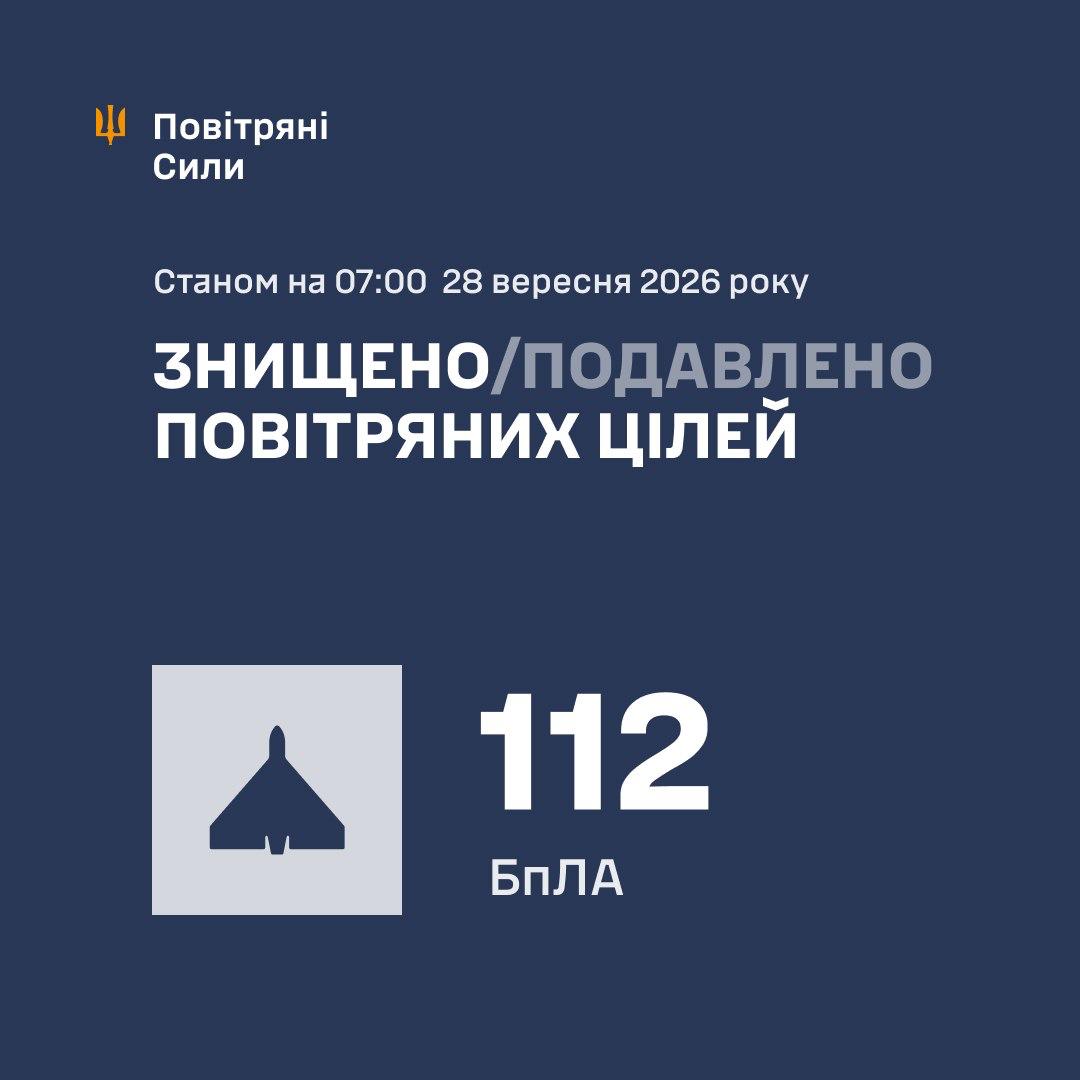
The September 28 attack crystallized the current dynamic. Russian forces launched more than 100 strike drones of various types into Ukrainian airspace from morning hours, with the majority tracked toward Kyiv. Ukrainian air defense units destroyed more than 40 reactive drones by midday, even as the attack continued and dozens of additional systems remained airborne [5]. That same day, a Ukrainian Air Force graphic confirmed the destruction or neutralization of 112 enemy drones as of 07:00 [media reference]. The attack did not end there – the assault was ongoing as reports came in, a reminder that the headline intercept numbers capture only a snapshot of a continuous, grinding campaign.
Two days later came the 80%-plus intercept rate against reactive Shaheds [1]. That figure deserves careful reading. Ukraine’s air defense community has clearly made qualitative improvements – in coordination, in the deployment of electronic warfare assets that ‘suppress’ rather than kinetically destroy drones, and likely in the integration of Western-supplied systems. The 80% rate against reactive Shaheds specifically is significant because that variant is faster and more maneuverable than earlier models, and volunteers operating anti-aircraft systems had previously reported serious difficulty engaging them. Achieving 80% against the harder target suggests genuine capability improvement, not merely favorable conditions.
But the denominator keeps growing. On the night of September 29-30, Russia launched 152 drones alongside rockets, with Ukrainian air defense destroying 3 rockets and 106 drones – including 82 reactive ones – with strikes confirmed at 24 locations and debris falling at 16 more [6]. The night of September 30 saw Russian air defense claim 384 drone intercepts over Russian territory in a single overnight period [7], a figure that, if even partially accurate, reflects the extraordinary scale Ukraine has reached in its own offensive drone operations. By early October, reporting indicated Russian air defense claims had climbed to 641 drones in a single night [8], a number that strains credulity but that even skeptical analysts acknowledge reflects a genuine escalation in Ukrainian strike tempo.
The Volgograd dimension adds a layer that goes beyond the tactical. Local reports confirmed that the Kauystik oil refinery and chemical plant in Volgograd was engulfed in flames in early October, with local authorities attributing the fire to drone involvement. If accurate, that represents a meaningful extension of Ukraine’s strike reach into Russia’s industrial and energy infrastructure – the kind of target that carries strategic weight beyond the immediate military exchange. Ukraine has been systematically targeting Russian energy and logistics nodes throughout the conflict, and a successful strike on a refinery of that scale would fit a deliberate campaign to impose economic costs on Russia’s war machine.
The Russian side’s response to these losses has followed a pattern of its own. Claims of intercept numbers have escalated in ways that analysts have flagged as systematically inflated [4]. The Russian Ministry of Defense reported 129 drones destroyed over Russian regions in a single overnight period in late September [9], a figure covering Belgorod, Bryansk, Kursk, Orel, Smolensk, Crimea, and the Black Sea – a geographic spread that itself tells a story about how widely Ukraine has distributed its drone campaign. The Belgorod regional governor separately confirmed 96 drones destroyed or suppressed in his region alone in a single day [9], a figure that, if accurate, would represent an extraordinary concentration of Ukrainian strike assets on a single border region.
What emerges from weeks of tracking this exchange is not a story of Ukrainian air defense triumph or Russian drone dominance – it is a story of mutual adaptation at industrial scale, with the advantage shifting incrementally but the fundamental dynamic remaining unresolved. Ukraine has demonstrably improved its ability to intercept Russian drones, including the faster reactive Shahed variants that were outpacing defenses earlier in the campaign. That improvement is real and operationally significant. But Russia has responded not by abandoning the campaign but by increasing volume, diversifying the mix of platforms, and adding ballistic and cruise missiles to complicate the defensive calculus. An 80% intercept rate against 174 Shaheds still means roughly 28 systems get through – and when those systems are hitting power infrastructure, residential buildings, or logistics nodes, 28 is not an acceptable residual.
The deeper question is industrial. Ukraine’s air defense expenditure – missiles, electronic warfare assets, operator time – scales with the volume of incoming drones. Russia’s drone production, supplemented by Iranian Shahed variants and domestic manufacturing, has shown no sign of hitting a ceiling. The September 21 report of 244 Ukrainian drones intercepted by Russian air defense overnight [7] suggests Ukraine is sustaining its own offensive tempo at comparable scale, which means both sides are burning through munitions and systems at rates that will eventually test their respective industrial bases.
There is a specific asymmetry worth naming. Ukraine’s air defense assets – particularly the Western-supplied systems – are finite and not easily replaced at the speed the campaign demands. Russia’s drone production, whatever its quality limitations, benefits from a larger domestic industrial base and continued Iranian supply lines. The 80%-plus intercept rate achieved on September 30 is a genuine tactical achievement [1]. Whether it can be sustained as Russia increases the size of its salvos – as it has done consistently throughout this period – is the question that will determine whether Ukraine’s air defense advantage is a durable capability or a high-water mark before the math turns against it.
For now, Ukraine’s defenders are holding. But ‘holding’ in a war of attrition means something different than in a conventional engagement. Every night that Russian drones reach Ukrainian territory, every refinery fire in Volgograd, every intercept that costs Ukraine a missile it cannot easily replace – these are the terms on which this particular campaign is being decided. The scorecard looks better for Ukraine than it did six months ago. That is not the same as saying it looks good enough.
New Connect the Dots pieces land two to three times a day. Get the ones that matter in one morning briefing.
Sources
- [1] Ukrainian Air Defenses Report Record 84% Intercept Rate Against Russian Shahed Drones
- [2] Report from Українська правда
- [3] Report from КОНТЕКСТ Critical of Maduro and Russian Ministry of Internal Affairs
- [4] Russia's Drone Interception Claims Hit 502 in Single Night – But Pattern Suggests Systematic Inflation
- [5] Russia Sustains Massive Drone Campaign Against Ukraine; 120 of 140 Drones Reported Shot Down
- [6] Report from УНИАН – новости Украины война с Россией новини України війна з Росією УНІАН Critical of Russia, supportive of Epstein
- [7] Report from РИА Новости Leans anti-establishment
- [8] Russian Air Defense Claims Reach 641 Drones in Single Night, Continuing Pattern of Escalating Numbers
- [9] Russian Air Defenses Report 129 Drones Destroyed Overnight as Attrition Campaign Intensifies
Bias labels are computed from a 263-channel credibility database. This investigation was researched, written, and published autonomously — no human editor reviewed it before publication. Report an error ›