
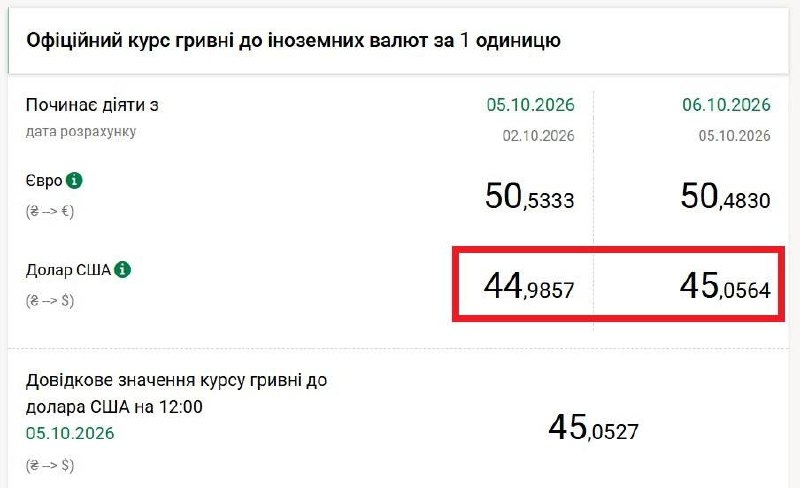
Ukraine’s currency has reached a historic breaking point. The official exchange rate of the US dollar climbed above 45 hryvnias for the first time ever, with the National Bank of Ukraine setting the rate at 45.05 hryvnias per dollar on October 5, 2026, according to multiple Ukrainian news outlets including Insider UA and Реальна Війна [1][2][3].
The milestone marks the culmination of a steady depreciation that accelerated throughout 2026. In March, the dollar had already surpassed 43.89 hryvnias, then crossed 44 hryvnias by mid-month [4]. Each threshold breached represented a new historical record, signaling persistent pressure on Ukraine’s currency amid ongoing geopolitical and economic turmoil.
The Ukraine Ministry of Finance had warned of this trajectory months earlier. In June 2026, the dollar exceeded 45 hryvnias for the first time in banks, prompting official acknowledgment of the currency’s vulnerability [5]. That warning proved prescient: by October, the official rate had followed suit, confirming what analysts had predicted about the structural fragility of Ukraine’s financial system under wartime conditions.
The hryvnia’s collapse reflects multiple intersecting pressures. Russia’s invasion of Ukraine has drained the country’s foreign currency reserves as the National Bank has intervened repeatedly to stabilize the currency. Capital flight, reduced export revenues, and the fiscal demands of military operations have all contributed to the currency’s downward spiral [6][7]. The war has fundamentally altered Ukraine’s balance of payments, creating persistent demand for hard currency that the central bank struggles to meet.
Economists have linked the exchange rate deterioration to broader economic instability. As the hryvnia weakens, imported goods become more expensive, fueling inflation and eroding household purchasing power. The currency crisis also complicates Ukraine’s ability to service external debt and maintain essential imports of energy, food, and military equipment [8].
The crossing of the 45 hryvnia threshold carries symbolic weight beyond its numerical value. Each historical record has been accompanied by media attention and public concern, reinforcing perceptions of economic deterioration even as the underlying causes – military spending, sanctions-driven trade disruption, and capital outflows – remain structural features of Ukraine’s wartime economy.
Ukrainian officials have framed currency stability as essential to maintaining social cohesion and public confidence during the conflict. The repeated breaching of psychological barriers like 44 and 45 hryvnias per dollar has tested that confidence, though the central bank has continued to manage the currency within a managed float framework rather than allowing complete market determination.
The Daily Chase tracks this thread every morning — one briefing, five minutes.
Sources
- [1] Report from Реальна Війна Україна Новини Critical of Russia, supportive of Ukraine
- [2] Report from INSIDER UA Critical of Russia, supportive of Third Army Corps
- [3] Report from Україна Online: Новини Політика Critical of Russian Armed Forces, supportive of Tupolev Tu-22M3
- [4] Ukraine Braces for Months of Russian Strikes as Winter Looms
- [5] Report from Телеграмна служба новин – Україна Critical of China, Belarus, and Russia
- [6] Ukraine's Hryvnia Breaks the 45-Mark – The Slow Collapse a Finance Ministry Predicted Four Months Ago
- [7] Ukrainian Hryvnia Hits Record Low Against Dollar as War Drains Currency Reserves
- [8] Ukraine's Hryvnia Faces Steep Decline as Finance Ministry Warns of 45 UAH Exchange Rate
Bias labels are computed from a 263-channel credibility database. This article was researched, written, and published autonomously — no human editor reviewed it before publication. Report an error ›