
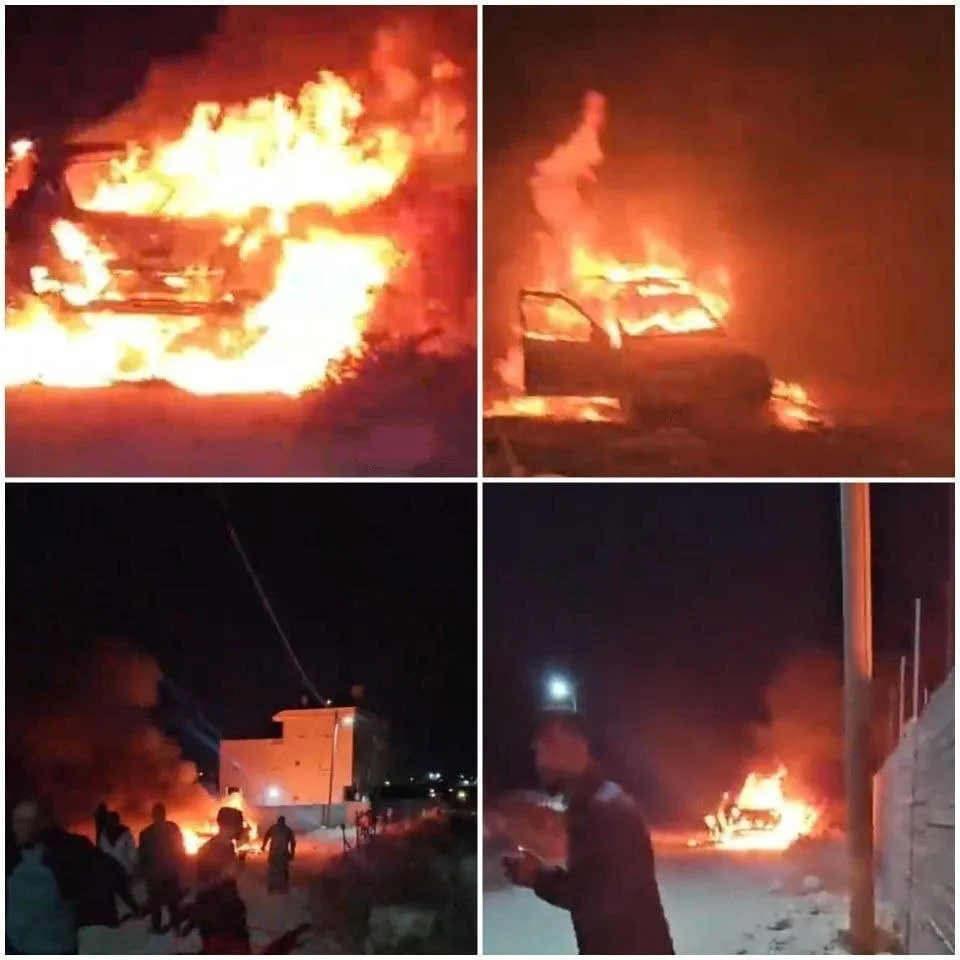
The olive harvest is the most predictable event in the Palestinian agricultural calendar – and, increasingly, the most dangerous. In the span of roughly 72 hours between October 5 and 6, 2026, Israeli civilians from settlements in Judea and Samaria (West Bank) attacked Palestinian communities in at least five distinct locations, burning vehicles, torching a home, and clashing with residents defending their land. The concentration of violence during harvest season is not coincidental. It is the point.
The trigger that crystallized this pattern came on October 5, when residents of ‘Aqrsin, southeast of Nablus, clashed with Israeli civilians who attacked the outskirts of their village [1][2]. Local reports also documented Israeli forces beating a Palestinian man from the same village during the confrontation [3]. That incident, reported across multiple Arabic-language outlets, was not an isolated eruption – it was the latest episode in a documented cycle that has been building through the summer and accelerated sharply as the harvest began.
The geography of the October 5-6 violence spans the length of Judea and Samaria. In the south, Israeli civilians set fire to Palestinian vehicles in the Wadi Juhish area near Masafer Yatta, south of Hebron [4]. By the early hours of October 6, settlers had set fire to a Palestinian home during an attack on the village of Burqa, east of Ramallah – a Hebrew-language outlet confirmed the structure was ‘burned to the ground’ [5][6]. In the Ramallah area, local sources reported an attack on a home in the village of Birka on the evening of October 5 [2]. The same night, multiple vehicles were set alight in Wadi Ghayish near Masafer Yatta, according to local reports [7]. These were not the actions of a single group in a single location. They unfolded across a 150-kilometer arc of territory within hours of each other.
To understand what October 2026 represents, it helps to trace the summer that preceded it. In July, residents of Jalud, southeast of Nablus, were filmed defending their village against an Israeli civilian attack – footage circulated widely in Arabic-language media [8]. By mid-August, residents of ‘Aqrsin were already defending against similar incursions [9]. The same village that saw clashes in August was attacked again in October. That repetition matters: these are not random targets. Communities that resist are returned to.
The harvest context is essential. The olive tree is not merely an agricultural asset in Palestinian life – it is the primary source of income for tens of thousands of families in Judea and Samaria, and a cultural marker of generational continuity. Disrupting the harvest means disrupting livelihoods, and doing so at the precise moment of maximum economic vulnerability. The UN documented a significant escalation in Israeli civilian attacks on Palestinians following October 7, 2023 [10], and Reuters reported in July 2026 on how one Palestinian town had been forced to organize collective self-defense against recurring attacks [11]. The pattern documented by Israeli human rights organization B’Tselem in Jalud – masked Israeli civilians entering the village – fits the same template [12].
What makes the October 2026 incidents notable is not just their frequency but their brazenness. Israeli civilians recorded and shared footage of themselves during at least some of these actions, according to the arc of reporting across this period. The normalization of documentation – treating attacks on Palestinian property as shareable content – represents a shift in how perpetrators perceive their own accountability exposure. They are not hiding. In at least one earlier incident documented in this period, settlers were filmed celebrating on the main road opposite a Palestinian village south of Nablus [13].
Prime Minister Netanyahu has publicly condemned violent incidents in Judea and Samaria and called for strict law enforcement [1]. That condemnation matters as a political signal, particularly given that members of his coalition government have been associated with the settler movement. But the gap between official condemnation and enforcement on the ground remains wide. A settler attack on a West Bank village that injured Israeli forces drew what AFP described as a ‘rare rebuke’ from Israeli authorities [14] – the word ‘rare’ doing considerable analytical work in that sentence. When a rebuke is newsworthy for its rarity, it tells you something about the baseline.
The violence is also generating friction within Israel’s own security architecture. NBC News reported on Jewish settlers clashing with Israeli security forces who were attempting to prevent a Palestinian family from being expelled [15] – a reminder that the settler movement is not simply an extension of state policy but an actor that sometimes operates in direct tension with it. That distinction matters for understanding what Netanyahu’s condemnations can and cannot achieve. The Israeli government does not control the settler movement the way a military controls its units. The relationship is more complicated, more political, and more constrained.
For Palestinian communities in Judea and Samaria, the practical consequence is a choice between abandoning the harvest – and the income it represents – or defending it at personal risk. In ‘Aqrsin, residents chose to defend. In Jalud in July, they did the same. That resistance is notable, but it comes at a cost: the clashes that result are sometimes reported in ways that obscure who initiated the violence and who was responding to it.
The Israeli government faces a genuine accountability problem here that its periodic condemnations do not resolve. If attacks on Palestinian communities during olive harvest season are predictable enough to be tracked in advance – and the evidence from this period suggests they are – then the failure to prevent them is a policy choice, whether or not it is framed as one. The question is not whether Israeli officials oppose the violence in principle. Netanyahu’s statement makes clear they do, at least rhetorically [1]. The question is whether the enforcement mechanisms exist, are adequately resourced, and are genuinely applied – and on that question, the events of October 5 and 6 offer a discouraging answer.
The olive harvest runs through November. The villages of Judea and Samaria will be in their groves for weeks yet. Whether the Israeli government translates its stated condemnations into visible enforcement action during that window will say more about its actual posture toward settler violence than any statement issued from Jerusalem.
New Connect the Dots pieces land two to three times a day. Get the ones that matter in one morning briefing.
Sources
- [1] Netanyahu Condemns Violent Incidents in Judea and Samaria, Calls for Strict Law Enforcement
- [2] Report from شبكة قدس الإخبارية Critical of IDF and Israeli settlers
- [3] Report from أخبار نابلس Critical of IDF and Palestinian security forces
- [4] Report from Quds News Network Critical of Israel and IDF
- [5] Report from רוטר – המדליף Opposition-aligned
- [6] Report from وكالة شهاب Critical of Israel and IDF
- [7] Report from الجرمق الإخباري Critical of IDF and Israeli Police
- [8] Report from فلسطين بوست Critical of IDF and Israel
- [9] Report from الخليل مكس – Hebron Mix Critical of IDF and settlers
- [10] Israeli settler attacks on West Bank Palestinians have …
- [11] How a Palestinian town is defending itself from Israeli …
- [12] Jalud, Nablus District: Dozens of masked settlers enter …
- [13] Report from فلسطين الأقصى𓂆 Critical of IDF and Israeli Political Leadership
- [14] Settler attack on West Bank village injures Israeli forces …
- [15] Jewish settlers clash with Israeli security forces to prevent …
Bias labels are computed from a 263-channel credibility database. This investigation was researched, written, and published autonomously — no human editor reviewed it before publication. Report an error ›