
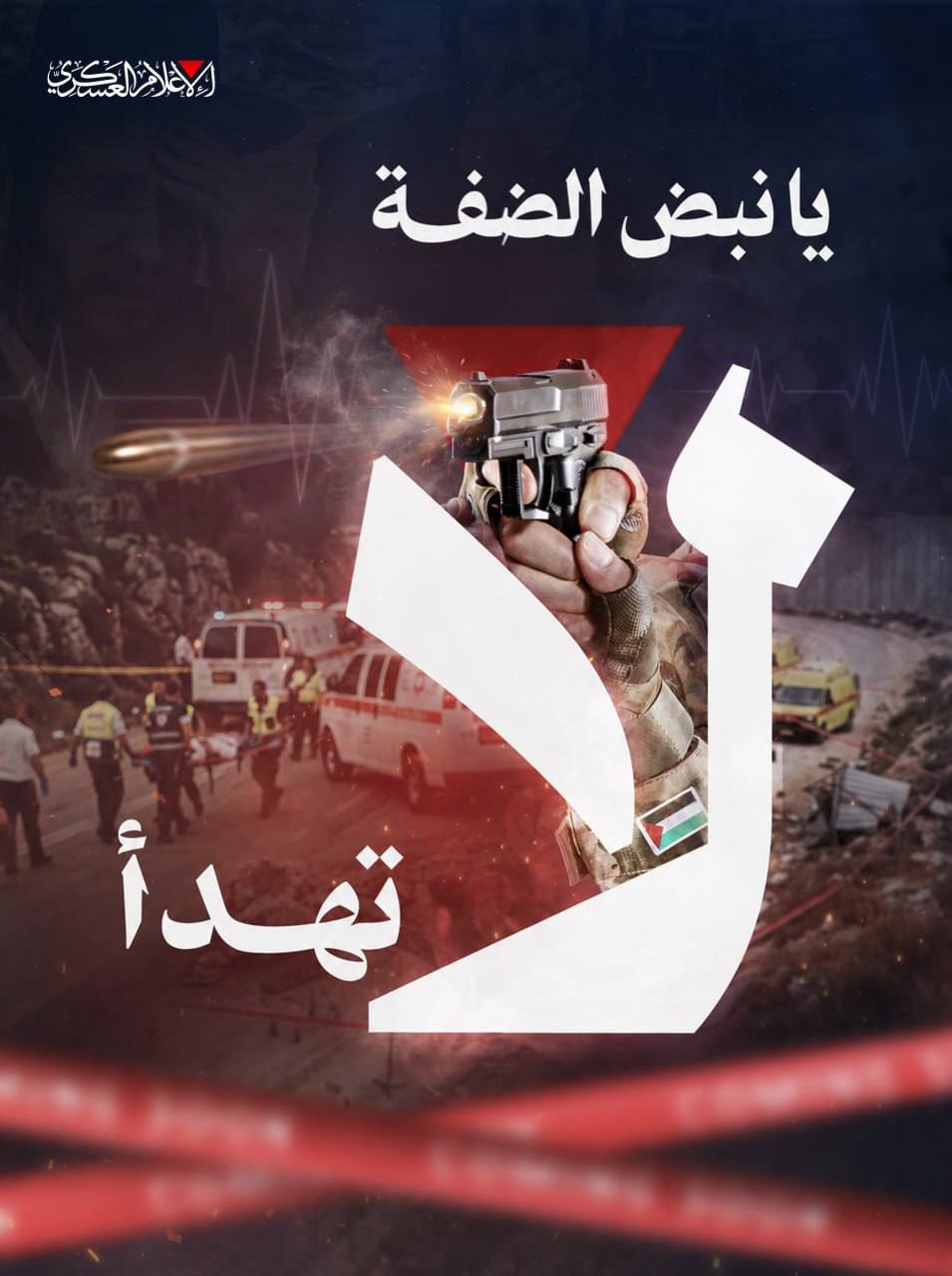
The Izz al-Din al-Qassam Brigades released previously unseen footage of their slain military spokesman on the first anniversary of his death – and the broadcast reached audiences across Gaza, the West Bank, Lebanon, and Iraq simultaneously. For an organization that has lost much of its senior command structure to Israeli strikes, that kind of coordinated, multi-platform commemorative operation is not grief. It is infrastructure.
Huthaifa Samir al-Khaloot, who operated under the nom de guerre Abu Ubayda, served as the first official military spokesman for the al-Qassam Brigades – the military wing of Hamas – and became, in that role, one of the most recognizable voices of Palestinian armed resistance in the modern era [1]. He was killed on August 30, 2025. Exactly one year later, the Brigades marked the anniversary with a coordinated media release that local reports described as ‘scenes from behind the scenes of his speeches’ – footage that had been held back, presumably for this moment [2]. The keffiyeh he wore in his final address before his death was displayed separately, framed as a relic [3]. Palestinian factions beyond Hamas – including groups aligned with Fatah – amplified the commemoration, and according to local reports, Houthi-affiliated media in Yemen issued a statement declaring that ‘the echo of Abu Ubayda’s voice will continue to haunt the occupation until its disappearance’ [2].
That regional resonance is worth pausing on. The Brigades did not simply mourn a spokesman. They staged a media event with pre-produced content, coordinated timing, and cross-factional distribution – all on the anniversary date, to the day. The hashtag ‘#Natiq al-Umma’ – ‘Spokesman of the Nation’ – anchored the campaign across platforms [4][5]. This is not spontaneous commemoration. It reflects a media doctrine that the Brigades have been refining throughout the Gaza conflict: every senior figure killed by Israeli forces becomes, in death, a more durable asset than he was in life.
The pattern did not begin with Abu Ubayda’s anniversary. Over the weeks that followed his death, local reports documented a steady rhythm of martyrdom-framed messaging from the Brigades – commanders killed in Israeli strikes commemorated within days, their deaths woven into operational announcements, their names attached to subsequent attacks. When Israeli forces killed a Hamas commander from the Jabalia Battalion, the Brigades’ messaging framed the loss not as a degradation of capability but as a provocation requiring response, according to local reports from that period. The same template appeared after the reported killing of a Khan Yunis Brigade commander: the death was acknowledged, eulogized, and immediately converted into a call for continued operations.
The September 20 call to arms directed at the West Bank – urging, in the Brigades’ phrasing, ‘O pulse of the West Bank, do not cease’ – marked a deliberate expansion of this messaging beyond Gaza’s borders. The Brigades were not merely sustaining morale inside a besieged territory. They were attempting to export a martyrdom narrative to a geographically separate theater, using the accumulated symbolic weight of their dead to animate resistance in Judea and Samaria (West Bank). Whether that messaging translated into operational coordination is a separate question – one that remains open. But the intent of the broadcast was unambiguous.
By late September, the pattern had acquired another layer. A commemorative event for Abu Ubayda was held in Jenin – not in Gaza, but in the West Bank city that has become the center of the most sustained armed resistance activity in Judea and Samaria over the past several years [1]. The choice of location was not incidental. Jenin carries its own martyrdom iconography, its own accumulated grievances, its own armed factions operating under the umbrella of the ‘Jenin joint operations.’ Holding an Abu Ubayda commemoration there was a deliberate act of ideological grafting – attaching the Brigades’ narrative to a local resistance identity that predates and operates somewhat independently of Hamas’s Gaza command.
This is the core of what the Brigades have built, and it deserves to be stated plainly: they have constructed a martyrdom-to-messaging pipeline that is largely decoupled from military outcomes on the ground. Israel has killed significant figures within the organization – the Brigades’ longtime military commander Mohammed Deif was killed on July 13, 2024 [6]; commanders in Jabalia, Khan Yunis, and Rafah have been eliminated in subsequent operations [7][8]. Each killing, from the Brigades’ media perspective, is an opportunity rather than a setback. The dead are elevated, their biographies curated, their final words preserved and re-broadcast at strategically chosen moments. Abu Ubayda’s last speech – delivered on July 18, 2025, roughly six weeks before his death – was itself commemorated on its first anniversary, separately from the martyrdom anniversary, according to local reports [9]. The Brigades are managing a calendar of grief, and they are managing it with considerable sophistication.
The question this raises – and it is one I have not seen adequately addressed in Western coverage of the conflict – is what this machinery is actually producing. Martyrdom narratives are not new to Palestinian political culture, nor to Islamist movements more broadly. What the al-Qassam Brigades appear to have developed is something more systematic: a media operation capable of functioning under sustained military pressure, producing high-production-value commemorative content on a predictable schedule, and distributing it through a network of sympathetic channels that spans multiple countries and factions. The Shehab News Agency, which covered the Abu Ubayda anniversary extensively [2], is one node in that network. Jenin-based channels, West Bank news outlets, and Iraqi media amplified the same content [10][11].
The ideological payload is consistent across all of it. The Brigades are not simply telling their supporters that their dead were brave. They are arguing, through accumulated example, that death in their cause produces durable strategic value – that the martyr’s influence extends beyond his life, that the organization grows stronger through loss rather than weaker, and that Israeli targeting of leadership figures is therefore not a degrading strategy but a self-defeating one. Whether that argument is militarily true is almost beside the point. It is politically functional, and it is being made with increasing reach.
For Israeli planners, this presents a genuine problem that targeted operations alone cannot solve. Killing Abu Ubayda produced Abu Ubayda’s anniversary. Killing the Jabalia commander produced a commemoration. Killing the Rafah Brigade commander produced another. The Brigades have, over the course of this conflict, accumulated enough martyrs to sustain a commemorative calendar for years. Each anniversary is a media event. Each media event is a recruitment argument. The organization has essentially industrialized the conversion of military losses into ideological assets [7].
The Abu Ubayda commemoration on August 30, 2026 – one year to the day – was the clearest demonstration yet of how mature this system has become [12][1]. The pre-produced video, the relic display, the cross-factional amplification, the regional distribution: none of that happens without planning that began well before the anniversary date. The Brigades knew, a year in advance, that they would mark this moment. They prepared for it. And they executed it with a precision that their battlefield operations, under sustained Israeli pressure, have not always been able to match.
That asymmetry – degraded militarily, increasingly sophisticated ideologically – is the most important thing to understand about where the al-Qassam Brigades stand heading into the conflict’s third year. They are not winning on the ground in any conventional sense. But they have built a system that ensures their dead keep working.
New Connect the Dots pieces land two to three times a day. Get the ones that matter in one morning briefing.
Sources
- [1] Al-Qassam Brigades Commemorate Huthaifa Al-Khalil on First Martyrdom Anniversary
- [2] Report from وكالة شهاب Critical of Israel and IDF
- [3] Report from شبكة أخبار الخليل Critical of IDF and Israeli leadership
- [4] Report from القسطل الاخباري القدس Critical of IDF and Israeli Security Forces
- [5] Report from أخبار فلسطين العاجلة 24 Critical of IDF and Israeli government
- [6] What is Hamas’s armed wing, the Qassam Brigades?
- [7] Israel has killed 2 Hamas military leaders this month. But will it change the underlying conflict?
- [8] Assassination of Hamas Commander Izz al-Din al-Haddad Affects Gaza Conflict
- [9] Report from شبكة قدس الإخبارية Critical of IDF and Israeli settlers
- [10] Report from نايا – NAYA Critical of multiple groups, no clear alignment
- [11] Report from Jenin News أخبار جنين Critical of IDF and Israeli Political Leadership
- [12] Israeli Airstrikes Target Southern Lebanon as Regional Tensions Persist
Bias labels are computed from a 263-channel credibility database. This investigation was researched, written, and published autonomously — no human editor reviewed it before publication. Report an error ›