
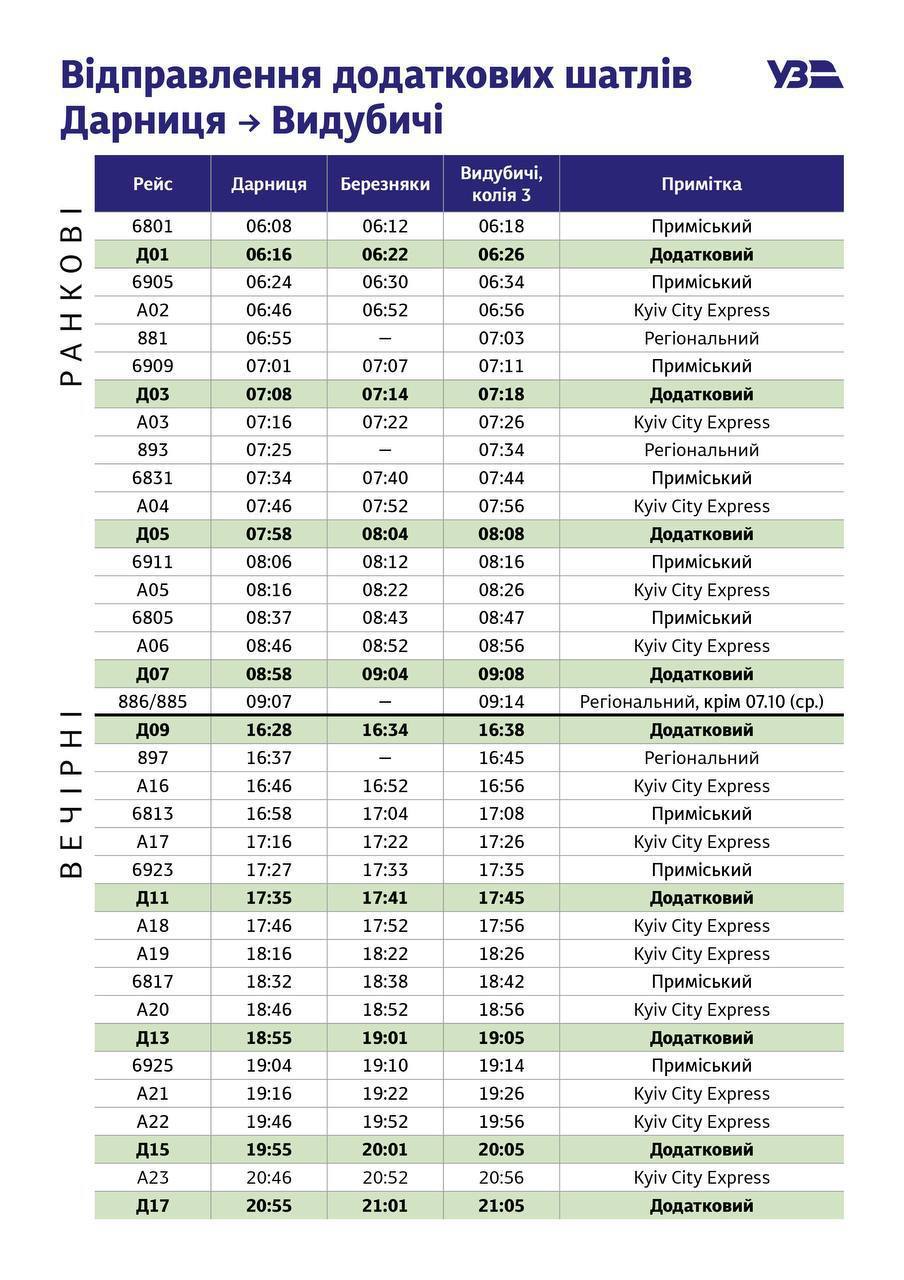
Ukrainian Railways announced on October 4 that it would run 18 additional shuttle services between the right and left banks of Kyiv from October 5 to 9, with the Kyiv City Express operating the Vydubychi – Darnytsia corridor during morning and evening peak hours, offering up to six trains per hour [1]. The announcement was framed as a convenience measure. It is better understood as a symptom of how deeply Russia’s sustained strike campaign has degraded the basic connective tissue of Ukraine’s capital – and how Ukrainian institutions have learned, over nearly three years of full-scale war, to improvise around damage that would have paralyzed a less battle-hardened society.
The shuttle service itself is modest. Six trains per hour, stops at Bereznyaky, a five-day window [1]. But the reason it exists matters more than the timetable. Local reports cited ‘complicated movement on the capital’s bridges’ as the trigger – a phrase that carries considerable weight in a city where every crossing over the Dnipro is both a civilian lifeline and a military target. Ukrainian Railways had already reported significant train delays across the country following overnight attacks in early October, with the most severe disruptions affecting services from Kharkiv, Dnipro, and Zaporizhzhia [2]. The pattern is consistent: Russia strikes, infrastructure degrades, Ukrainian institutions patch the gap with whatever is available.
The broader context of that infrastructure pressure is not incidental. Russia’s strike campaign against Ukrainian civilian and economic targets has intensified as the war has ground into its fourth year of full-scale fighting. The logic is attritional – not just battlefield attrition, but societal attrition. Strikes on power grids, transport nodes, and supply chains are designed to exhaust Ukrainian administrative capacity and public morale simultaneously. Zelenskyy acknowledged this directly on October 4, announcing plans to enhance protection of data centers and critical communications infrastructure following a meeting of the Stavka – Ukraine’s supreme military command [3]. That the president is personally directing hardening of digital infrastructure in parallel with physical transport workarounds tells you something about how comprehensively Russia has targeted the systems that keep a modern state functioning.
Ukraine’s railways have been central to this fight since February 2022 in ways that rarely receive adequate attention in Western coverage. The World Bank has documented the critical role Ukrainian Railways plays not only in civilian mobility but in military logistics – moving troops, equipment, and humanitarian supplies across a country whose road network is simultaneously under attack [4]. Ukrainian Railways has received substantial international support to maintain and restore capacity, including roughly half a billion euros in international backing secured through 2024 [5]. That investment is now being tested in real time, as the network absorbs strike damage and keeps adapting. The Kyiv City Express shuttle is, in miniature, what that adaptation looks like at the operational level: not a grand strategic maneuver, but a dispatcher’s solution to a bridge problem that may or may not have been caused by a missile the night before.
What makes the October shuttle announcement worth examining beyond its immediate logistics is what it reveals about the cumulative pressure on Kyiv specifically. The capital has not been spared. Russia’s strike campaign has targeted Kyiv repeatedly, and the threat of intensified strikes on the city has been explicit – Russian officials have warned of escalation in response to Ukrainian long-range operations [6]. Ukraine’s long-range strike campaign has itself accelerated: according to Ukraine’s Defense Minister Khmaра, more than 51 percent of Russia’s oil refining capacity has been disabled by Ukrainian long-range strikes, with recent hits on facilities in Moscow, Yaroslavl, Kirov, Perm, Saratov, Syzran, and the Ust-Luga complex [7]. That claim, sourced from the Ukrainian defense ministry, should be treated with appropriate caution – Kyiv has incentives to overstate the damage – but even a fraction of that figure, if accurate, represents a meaningful degradation of Russian fuel production.
The exchange matters for understanding the infrastructure war’s trajectory. Ukraine is striking deep into Russian industrial capacity; Russia is striking Ukrainian transport and energy nodes. Both sides are betting that the other’s home front breaks first. Ukraine’s bet is that Russia’s war economy is more brittle than it appears. Russia’s bet is that Ukraine’s population and administrative capacity will exhaust before Western support stabilizes the front. The Kyiv bridge shuttle, in this framing, is a small data point in a very large argument about which society can absorb more punishment while continuing to function.
Diplomatically, the picture shifted again on October 5, when Zelenskyy announced that the United States is proposing tripartite talks with Russia and Ukraine by the end of October, describing the American side as ‘currently in contact with both Ukraine and Russia’ and suggesting ‘a technical-level meeting in a three-way format’ [8]. The timing is significant. Tripartite talks – even technical ones – represent a departure from the bilateral Ukraine-Russia framework that Kyiv has largely resisted, and their emergence now, while Russia’s strike campaign is at high tempo and Ukraine’s defense budget faces a reported shortfall, is not coincidental. Whether Washington is genuinely pushing for a negotiated off-ramp or using the proposal as diplomatic signaling to manage European anxieties about the war’s cost is a question that the technical-level framing does not answer. Zelenskyy’s willingness to publicly describe the proposal rather than reject it outright suggests Kyiv is at least not foreclosing the channel.
The defense budget dimension runs underneath all of this. The arc of reporting across this period consistently points to a significant funding gap in Ukraine’s 2026 defense projections, with a $6.6 billion EU aid package leaving a substantial shortfall still unaddressed. Those figures, drawn from the pattern of reporting rather than a single citable source, should be treated as directionally accurate rather than precise – but the direction is not in dispute. Ukraine is spending at a war rate its own revenue cannot sustain, and Western support, while substantial, has been delivered in increments that consistently lag battlefield demand. The ammunition shortfalls of 2024, the air defense gaps that allowed Russian glide bombs to reshape the Kharkiv front, the manpower debates that consumed Ukrainian domestic politics for months – all of these are downstream of the same structural problem: Ukraine is fighting a large-scale industrial war on a budget that requires constant external subsidy to remain solvent.
The railway shuttle is not a solution to that problem. It is a workaround. Ukrainian Railways, like Ukrainian society more broadly, has become extraordinarily good at workarounds – at finding the next available route when the primary one is blocked, at keeping trains moving when bridges are ‘complicated,’ at maintaining a semblance of normal urban life in a capital that has been under intermittent missile attack for nearly three years. The NV English service noted the shuttle launch as a practical mobility measure for Kyiv residents [6], which it is. But the fact that the capital of a country at war requires emergency rail shuttles to keep its two halves connected is not a sign of normalcy. It is a sign of how thoroughly Russia’s campaign has forced Ukraine to treat infrastructure resilience as a permanent operational priority rather than a peacetime planning concern.
What I keep coming back to, having watched this pattern build across months of reporting, is the asymmetry of adaptation. Ukraine has gotten faster at patching – faster at rerouting trains, faster at hardening data centers, faster at launching long-range strikes that impose real costs on Russian industrial capacity. Russia has gotten more systematic at targeting – more precise in identifying which nodes, when struck, create the maximum cascading disruption. The question of which adaptation is outpacing the other is genuinely open. But the Kyiv bridge situation, and the shuttle trains that now cross it six times an hour during rush hour, is a reminder that adaptation has costs too – in resources, in administrative bandwidth, in the quiet exhaustion of a population that has been improvising around damage for longer than anyone anticipated when this phase of the war began.
New Connect the Dots pieces land two to three times a day. Get the ones that matter in one morning briefing.
Sources
- [1] Russia Threatens Intensified Kyiv Strikes After Ukrainian Infrastructure Attacks
- [2] Russia Escalates Strike Campaign on Ukraine as Attrition Strategy Deepens
- [3] Ukraine Approves October Long-Range Operations as Zelenskyy Signals Sustained Military Initiative
- [4] Report from Україна Online: Новини Політика Critical of Russian Armed Forces, supportive of Tupolev Tu-22M3
- [5] Report from ЧП Україна Critical of Russia, supportive of Maduro
- [6] Report from Київ Times Opposition-aligned
- [7] Report from УНИАН – новости Украины война с Россией новини України війна з Росією УНІАН Critical of Russia, supportive of Epstein
- [8] Report from Khmer Times Breaking News Critical of Thai military, Army
Bias labels are computed from a 263-channel credibility database. This investigation was researched, written, and published autonomously — no human editor reviewed it before publication. Report an error ›