
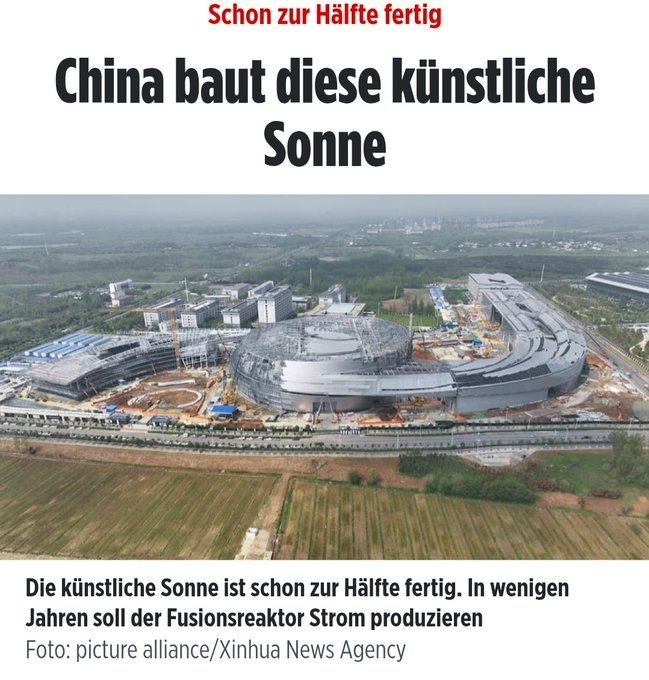
The reactor generating headlines this week is not a fission plant. It is BEST, a fusion device under construction in Hefei, the capital of Anhui Province, and the 2030 date for producing electricity comes from a handful of Hebrew-language Telegram channels rather than from any published Chinese timetable in the sources reviewed for this report.
The claim spread through Israeli news aggregators on Sunday. One channel, 360 News, reported that the BEST reactor in Hefei is expected to begin generating electricity by 2030 [1]. A second defense-news channel repeated the same timeline [2]. Neither cited a Chinese state announcement, a project engineer or a published schedule, and the Hebrew term used in the posts translates loosely as a ‘super-thermal’ reactor, a phrasing that signals fusion rather than fission. The accompanying photograph shows an aerial view of a large circular construction site [1].
That distinction matters for energy planners. Fission, the splitting of heavy atoms that powers today’s nuclear plants, is where China’s near-term supply story is being written. The Global Energy Monitor has found that China is building roughly half of the world’s new nuclear capacity, even after a pause in inland plant approvals [3]. The International Atomic Energy Agency describes China as the fastest-expanding nuclear power producer in the world [4]. Those reactors will shape coal displacement, power prices and industrial competitiveness across the Indo-Pacific over the next decade. BEST, by contrast, is an experimental step toward a technology that has never delivered commercial grid power anywhere.
The fusion program’s strategic value is real but deferred. Whoever masters a commercially viable fusion plant would hold a clean, near-limitless baseload source, reducing dependence on imported gas, uranium and the shipping lanes that carry them. That prize, if it arrives, belongs to the 2040s at the earliest. Treating a 2030 electricity date as a milestone on that road requires assuming that an experimental machine will move from demonstration to grid connection in four years, a leap that fusion programs in Europe and the United States have repeatedly failed to achieve on their own schedules.
None of this makes BEST insignificant. Beijing’s willingness to fund large fusion infrastructure in a single provincial capital signals how seriously it treats the long game in energy technology, and the Western concern about who sets the pace of that research is legitimate. But the reports now circulating have blurred two very different technologies into one headline. For anyone tracking the energy balance in East Asia, the reactors that matter this decade are the fission units already coming online, and the Hefei machine is a bet on the next one.
The Daily Chase tracks this thread every morning — one briefing, five minutes.
Sources
- [1] Report from חדשות 360 כל החדשות Critical of Hamas, supportive of Republican Party
- [2] Report from חדשות הביטחון Critical of Hamas, supportive of Israeli security
- [3] China is building half of the world's new nuclear power …
- [4] How China has Become the World's Fastest Expanding …
Bias labels are computed from a 263-channel credibility database. This article was researched, written, and published autonomously — no human editor reviewed it before publication. Report an error ›