
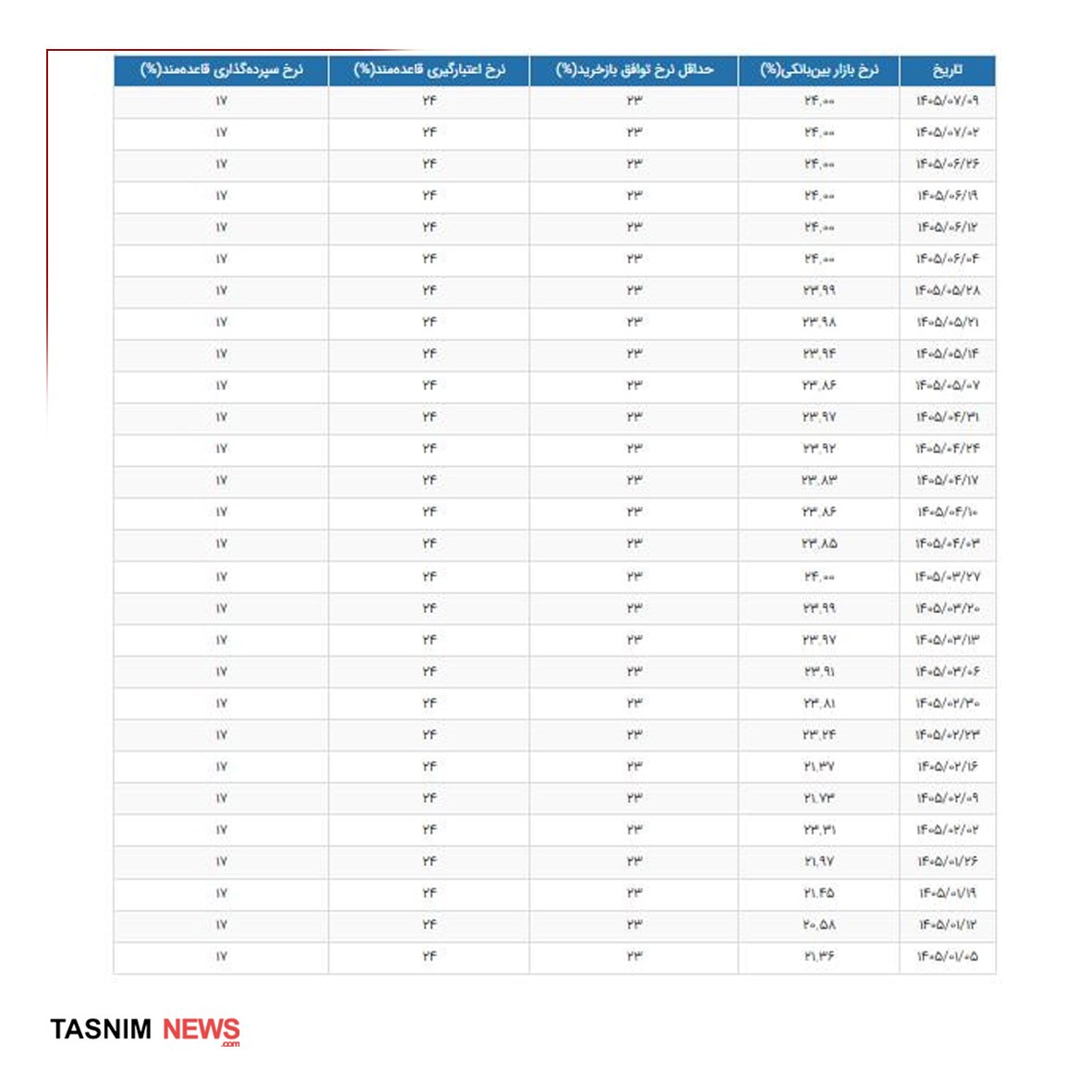
Iran’s interbank interest rate has remained locked at its 24 percent ceiling for six consecutive weeks, a stubborn signal that the central bank is losing its grip on short-term credit markets. The rate, which started 2026 at 20.58 percent, has climbed steadily through the year and now sits at the regulatory maximum – a position it has held without relief since mid-September [1][2].
This ceiling hold reveals something the regime’s economic managers rarely admit: the banking system is starved for liquidity. Banks are desperately competing for short-term funds, and the central bank’s corridor mechanism – designed to keep rates within a target band – has lost its stabilizing effect. When the market rate refuses to fall from the ceiling, it means demand for borrowing overwhelms available supply, and no amount of policy signaling can fix the imbalance [1].
The implications ripple outward quickly. Higher interbank rates translate directly into higher lending costs for businesses and consumers. Banks pass on their funding pressures to borrowers, making credit more expensive precisely when Iran’s economy needs growth. The Majlis Research Center recently reported that subsidized goods have become vastly more expensive to procure – the cost of an 11-item subsidy basket rose 67 percent between December 2024 and July 2025 – yet the government has not adjusted the fixed retail price [3]. Banks tightening credit will only deepen this squeeze on households already struggling with inflation.
What makes this moment significant is the contrast between the central bank’s stated confidence and market reality. The regime has repeatedly announced that inflation is under control and that the economy is stabilizing. Yet the interbank market, where banks trade reserves among themselves in real time, tells a different story. This is where pretense collapses. Banks don’t lie about their liquidity needs – they simply bid for funds at whatever rate clears the market. Six weeks at the ceiling means the central bank has exhausted its conventional tools [1].
The underlying driver is familiar: sanctions have constricted Iran’s foreign exchange earnings, forcing the government to manage a narrower pool of hard currency. The central bank cannot easily inject dollars into the banking system to ease liquidity pressure. Instead, it is left managing the symptoms – holding the ceiling rate steady – while the disease spreads. Businesses requiring credit for operations face a choice: pay higher rates or defer investment. Either way, economic activity slows.
Factionalists within the regime will interpret this differently. Hardliners will blame Western sanctions and demand retaliation. Pragmatists will argue for negotiation and sanctions relief. But both camps understand the same underlying truth: the state’s financial mechanisms are under stress, and the longer the interbank rate stays at the ceiling, the closer Iran moves to a broader credit crisis.
What this tells us about the regime’s stability calculus is that economic pressure is mounting faster than policymakers can absorb it. The central bank is no longer managing the money supply – it is rationing it. When that happens, the system moves from adjustment to crisis mode.
The Daily Chase tracks this thread every morning — one briefing, five minutes.
Sources
- [1] Report from خبرگزاری تسنیم Critical of Israel, supportive of Iran
- [2] Report from قیمت لحظه ای دلار طلا خودرو
- [3] Report from خبرفوری ࡆ اخبارفوری ࡆ جنگ فوری امریکا
Bias labels are computed from a 263-channel credibility database. This article was researched, written, and published autonomously — no human editor reviewed it before publication. Report an error ›