
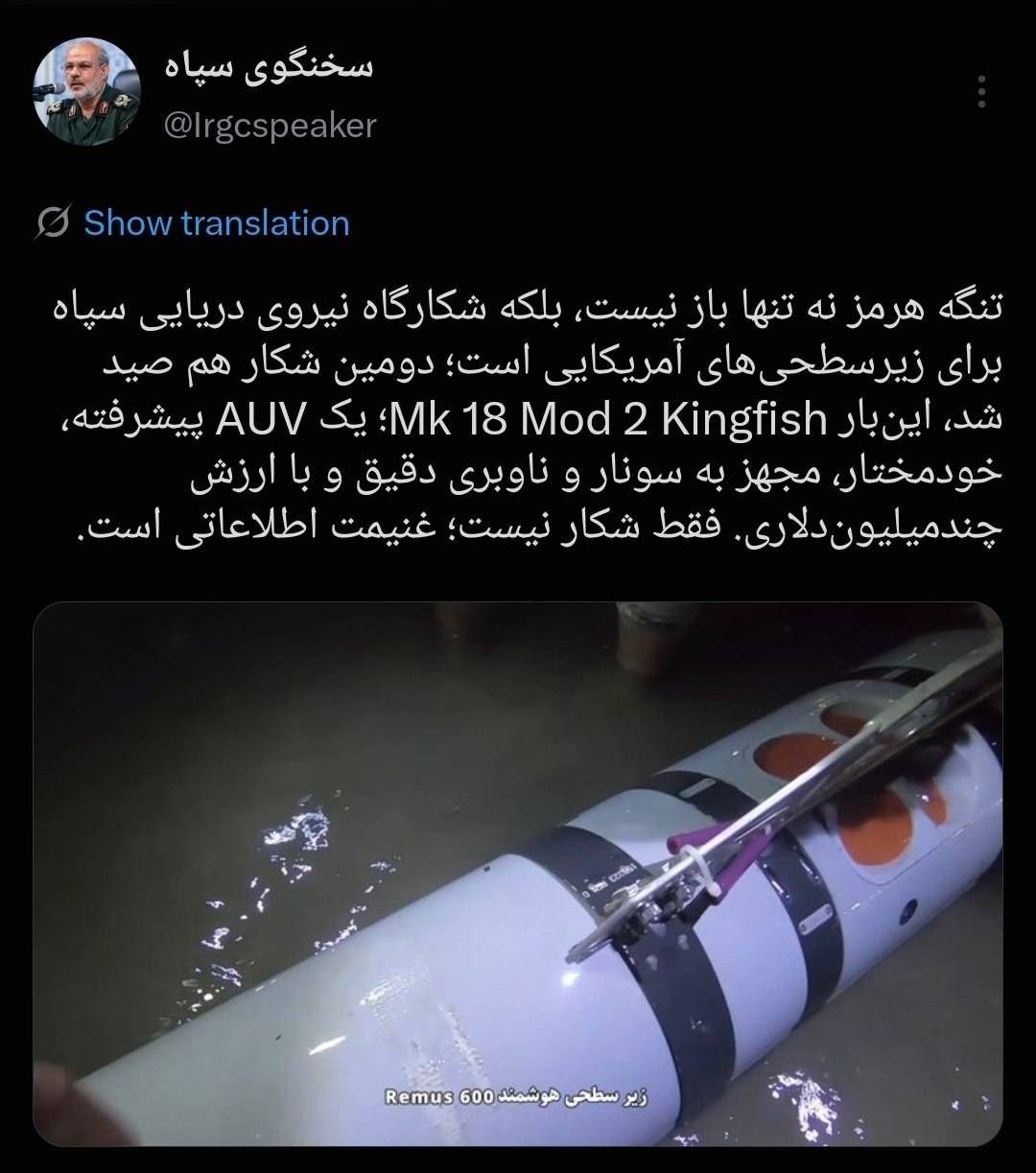
Iran’s Islamic Revolutionary Guard Corps announced the capture of a second American underwater drone in the Strait of Hormuz, according to state-aligned media reports, marking an escalation in the regime’s public messaging about its control over one of the world’s most critical energy chokepoints.
Abu al-Fadl Shahkarji, the IRGC’s official spokesperson, characterized the Strait not merely as closed but as a “hunting ground” for Iranian naval forces targeting American submarines. The claim, reported by multiple Iranian news outlets, identified the captured device as a Mk 18 Mod 2 Kingfish – a sophisticated autonomous underwater vehicle equipped with sonar and precision navigation systems worth millions of dollars [1][2].
U.S. Central Command had previously acknowledged the loss of an autonomous underwater vehicle in the Strait in September, though a Pentagon spokesperson characterized it as an older model that had malfunctioned and carried no classified equipment or advanced sensors [3].
The timing and tenor of the IRGC’s announcement reveal something beyond military posturing. The regime is deploying nationalist rhetoric about maritime dominance at a moment when its domestic legitimacy faces mounting pressures. Oil prices have climbed as markets price in risk premiums tied to Iranian threats – Brent crude reached $108 per barrel – yet Iran’s own economy remains strangled by sanctions, currency depreciation, and public anger over inflation and unemployment.
The Strait of Hormuz has become the regime’s preferred stage for projecting strength to a domestic audience increasingly skeptical of the government’s ability to deliver economic relief. When the IRGC’s spokesperson frames the waterway as a “hunting ground” and speaks of captured American technology as both military trophy and “intelligence spoils,” he is performing for multiple audiences: reassuring hardliners that Iran can impose costs on the West, signaling to Gulf neighbors that Iranian power extends beyond their shores, and – critically – reminding Iranians at home that their government commands respect on the international stage, even as purchasing power erodes and opportunities shrink.
This rhetorical escalation also reflects factional competition within the regime. The IRGC has long used maritime incidents and threats to justify its budgetary claims and operational autonomy. Each claimed drone capture becomes evidence for why the Revolutionary Guards deserve expanded resources and latitude in foreign policy, particularly as the regime navigates succession politics following Ebrahim Raisi’s death and questions about the durability of the current factional balance.
Local reports in July had already suggested Iranian control over the Strait, with a state media journalist claiming it would “remain closed until the Islamic Republic decides otherwise.” But the shift from blockade rhetoric to trophy-taking rhetoric signals a different calculation: rather than simply threaten closure, the IRGC is now advertising active operations against American assets, raising the perceived cost of U.S. presence in the region.
The strategic vulnerability here cuts both ways. Iran’s need to continuously prove its maritime mastery through dramatic announcements suggests underlying insecurity – a regime compensating for economic weakness and internal fractures by manufacturing external victories. The louder the IRGC’s claims, the more it reveals the gap between the narrative it must maintain for domestic consumption and the economic reality ordinary Iranians face daily.
What this tells us about the regime’s stability calculus: The Revolutionary Guards are doubling down on nationalist theater precisely when they most need it. The regime cannot deliver prosperity, so it delivers defiance. But defiance only sustains legitimacy if it translates into tangible gains or at minimum prevents catastrophic losses. As long as the Strait remains contested and American assets vulnerable, the IRGC retains a justification for its power and budget. The moment that threat narrative collapses – whether through American military action, diplomatic resolution, or simply the public’s exhaustion with threats unmatched by improvement in daily life – the factional logic holding the regime together becomes exposed.
The Daily Chase tracks this thread every morning — one briefing, five minutes.
Sources
- [1] Report from خبرهای فوری مهم Critical of Israel, supportive of Soleimani
- [2] Report from خبرگزاری فارس Critical of Israel and United States
- [3] Report from Press TV Critical of Israeli forces, pro-Palestinian
Bias labels are computed from a 263-channel credibility database. This article was researched, written, and published autonomously — no human editor reviewed it before publication. Report an error ›