
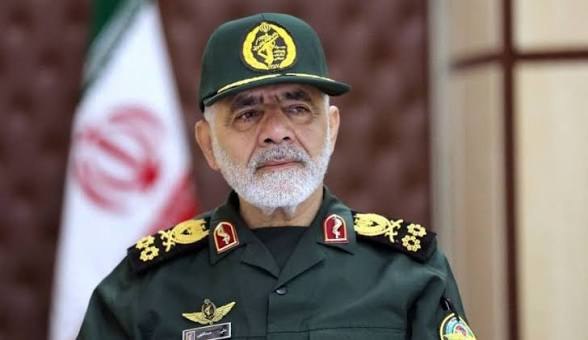
Iran’s armed forces chief issued an unequivocal threat on Monday, declaring that Tehran will respond with overwhelming force to any American or Israeli military action, whether before or after the U.S. elections and irrespective of their outcome. The statement, attributed to General Abdullahi, head of Iran’s Joint Chiefs of Staff, represents a significant escalation in rhetoric and signals the regime’s calculation that deterrence – not negotiation – is its primary tool.[1][2]
“Whether before or after the elections, and with any result, if the U.S. itself or at the instigation of the child-killing Zionist regime acts against Islamic Iran, the armed forces of the Islamic Republic will immediately, with intensity and power and in a painful manner, target American interests without limitation,” Abdullahi said, according to Persian-language state media reports.[2] He invoked Iran’s April 2024 ballistic missile strike – what Iranian officials call the “Ramadan war” – as proof of capability and willingness to execute large-scale retaliation.[1][2]
The timing of the threat is significant. It comes as former U.S. President Donald Trump, campaigning ahead of American midterm elections, has made sweeping claims about Iran’s military weakness and promised to “resolve the Iran issue” immediately after the vote. Trump asserted during a campaign event that Iran “no longer has an air force or navy,” a characterization that Iranian commanders have directly challenged.[3]
General Ali Fadavi, who advises Iran’s Islamic Revolutionary Guard Corps commander, responded to Trump’s claims separately, stating that the U.S. lacks the capability to exercise “complete sovereignty” through airpower alone and would require ground forces – a tacit acknowledgment of American military superiority while asserting that Iran’s defensive posture remains formidable.[4] Fadavi added that damage inflicted on the U.S. and its Western allies “cannot be compared” to harm sustained by the Islamic Republic, a rhetorical assertion unsupported by documented evidence but consistent with the regime’s domestic messaging.[4]
The dual-track messaging – Abdullahi’s unconditional retaliation threat and Fadavi’s implicit acknowledgment of asymmetric military imbalance – reflects the regime’s strategic posture. Iran cannot match American conventional military power, but it has invested heavily in asymmetric capabilities: ballistic missiles, drone swarms, and a network of proxy forces across Iraq, Syria, Lebanon, and Yemen. The April 2024 strike, in which Iran fired approximately 300 missiles and drones at Israeli territory, demonstrated this capability while also revealing significant interception rates and limited strategic impact.
Abdullahi’s statement that Iran will respond “whether before or after” U.S. elections is particularly revealing. It suggests the regime views the American electoral cycle as irrelevant to its strategic calculus and rejects any assumption that a change in U.S. administration might create diplomatic space. This positioning complicates any potential negotiating scenario, as it signals that Tehran sees military confrontation as more probable than diplomatic resolution in the near term.
The statement also reflects internal regime dynamics. Iranian military commanders have consistently adopted maximalist rhetoric to maintain domestic credibility and to signal to the Supreme Leader that they are the guardians of national security. This messaging is calibrated for Iranian audiences as much as for foreign adversaries. The invocation of the April 2024 strike, framed domestically as a successful “response” to an Israeli operation, serves to remind Iranians that the regime can project power beyond its borders – a critical claim for regime legitimacy amid widespread public discontent over economic collapse and governance failures.
What remains unclear is whether Abdullahi’s threat represents an actual shift in operational posture or rhetorical positioning ahead of potential escalation. The regime has a history of issuing threats that do not immediately translate into action. However, the unconditional language – “without limitation,” “immediately,” “with intensity and power” – removes ambiguity about intent, even if timing and scope remain undefined.
For American policymakers and Israeli security planners, the statement signals that deterrence through threat of retaliation may be less effective than previously assumed. If Iran’s leadership has already decided that retaliation is inevitable regardless of U.S. electoral outcomes, then the regime may be less susceptible to escalation-control measures or diplomatic off-ramps that depend on signaling restraint in response to American forbearance.
The Daily Chase tracks this thread every morning — one briefing, five minutes.
Sources
- [1] Report from آخرین خبر Leans anti-establishment
- [2] Report from خبرگزاری فارس Critical of Israel and United States
- [3] Report from آخرین خبر Leans anti-establishment
- [4] Report from Iran International ایران اینترنشنال Critical of Iranian government and protesters
Bias labels are computed from a 263-channel credibility database. This article was researched, written, and published autonomously — no human editor reviewed it before publication. Report an error ›