
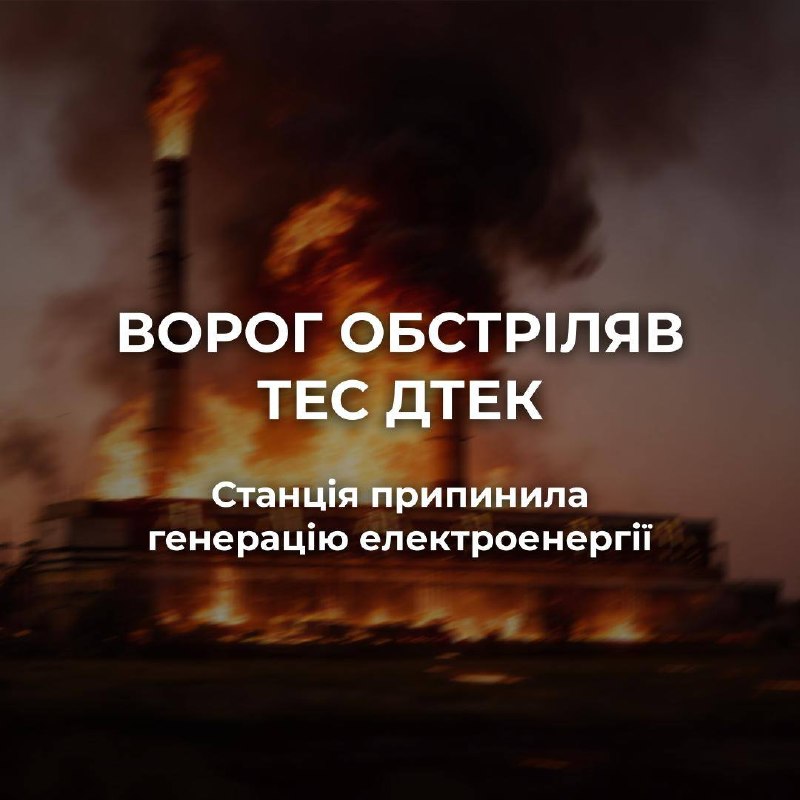
Russia conducted a coordinated strike against multiple Ukrainian thermal power plants and electrical substations on September 30, according to reports from Ukrainian sources, killing at least one worker and inflicting fresh damage on infrastructure already strained by months of sustained bombardment.
The attack targeted the Trypillia Thermal Power Plant, the Kharkiv TEC-5 facility, and the Darnytsia Thermal Power Plant in Kyiv, along with associated substations, according to local reports. One worker died at TEC-5 as a result of the strike [1].
The timing reflects a deliberate strategic pattern. Russia has shifted toward energy infrastructure as a primary target in recent months, moving beyond conventional military objectives to create civilian hardship as winter approaches. This mirrors tactics deployed during the previous winter offensive, when sustained attacks on the power grid left millions without heating and electricity during freezing months.
The scale of this campaign has been substantial. Since the full-scale invasion began in February 2022, DTEK’s thermal power plants – Ukraine’s largest private energy company – have absorbed over 220 strikes according to Ukrainian accounts, with at least eight major coordinated attacks since October 2025 alone [2]. One report indicated that 59 energy workers have been wounded and four killed across these facilities [2].
Ukrainian officials have not concealed the strategic objective behind these strikes. Valentyn Ignatiev, Ukraine’s energy minister, has publicly warned that Russia is attempting to create mass blackouts before winter sets in – a calculation that would force civilian evacuation from major cities and degrade Ukraine’s capacity to sustain military operations. The power grid serves dual purposes: civilian heating and lighting, and military-industrial production.
What distinguishes this phase of the war is the consistency of targeting. Rather than sporadic strikes, Russia appears committed to a grinding campaign of infrastructure degradation. Ukrainian monitoring sources indicated in February that Russia was preparing to deploy up to 600 attack drones and roughly 20 Iskander missiles in coordinated strikes, with TEC-5, TEC-6, and the Kyiv substation specifically named as priority targets [3].
The practical effect compounds over time. Each strike reduces generation capacity. Repairs become increasingly difficult as winter demand peaks and as Russian strikes target repair crews and replacement equipment. Ukraine’s energy company DTEK reported in August that a major power plant ceased electricity generation entirely following a Russian strike due to “substantial equipment damage” [4].
From a strategic perspective, this represents a shift in Russian targeting doctrine away from direct military confrontation toward civilian infrastructure attrition. The theory appears to be that sustained winter blackouts will break Ukrainian civilian morale and force resource allocation away from the front lines toward emergency heating and humanitarian response. Whether this calculation proves accurate depends on whether Ukraine can maintain sufficient generation capacity through the winter months and whether Western energy aid – including mobile generators and transformer replacements – arrives at sufficient scale.
The immediate question for Ukrainian planners is whether the remaining thermal capacity can meet winter demand. The longer-term question is whether Russia can sustain this campaign faster than Ukraine can repair and replace damaged infrastructure.
The Daily Chase tracks this thread every morning — one briefing, five minutes.
Sources
- [1] Report from Телеграмна служба новин – Україна Critical of China, Belarus, and Russia
- [2] Report from Київ Times Opposition-aligned
- [3] Report from Україна Online: Новини Політика Critical of Russian Armed Forces, supportive of Tupolev Tu-22M3
- [4] Report from Українська правда
Bias labels are computed from a 263-channel credibility database. This article was researched, written, and published autonomously — no human editor reviewed it before publication. Report an error ›