
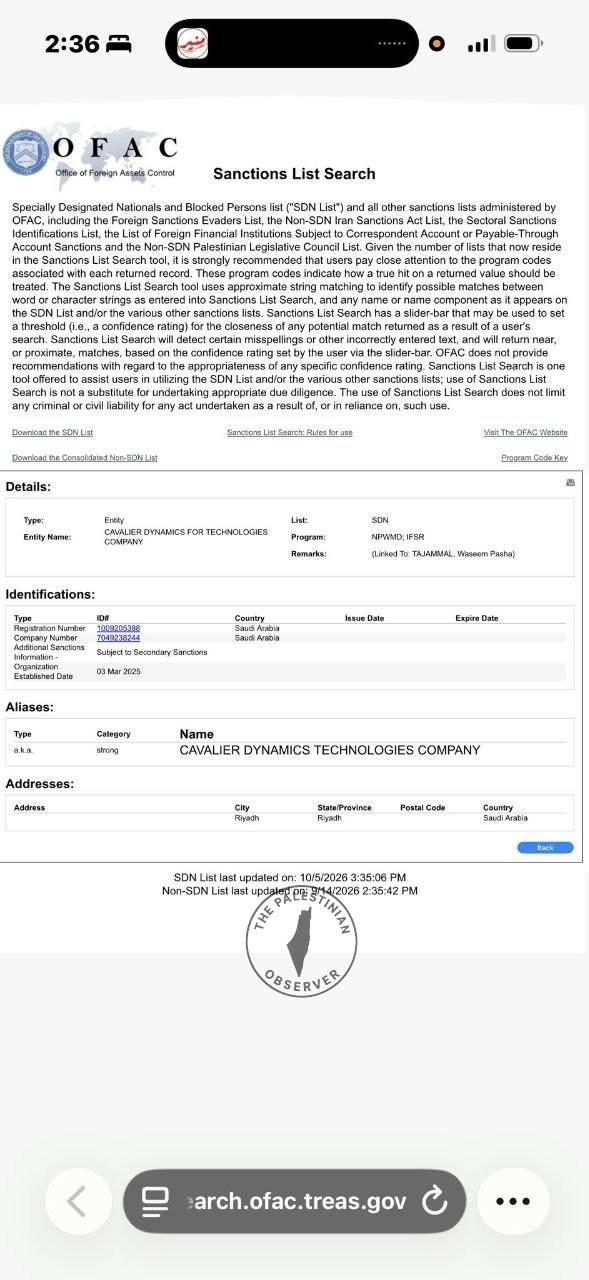
The U.S. Treasury Department has imposed sanctions on Cavalier Dynamics Technologies, a company based in Riyadh, alleging it operates as a front for Iranian weapons acquisition and distribution [1][2]. The designation marks an escalation in Washington’s effort to choke off Iran’s ability to source advanced military equipment through intermediaries in the Gulf – a persistent vulnerability in the sanctions regime that has allowed Tehran to circumvent restrictions despite years of economic pressure.
According to the Treasury’s Office of Foreign Assets Control (OFAC), Cavalier Dynamics acted on behalf of Iran to purchase and distribute weapons, leveraging its Saudi location to obscure the Iranian connection [1][2]. The company joins a growing list of Gulf-based entities sanctioned for facilitating Iranian procurement, a pattern that underscores how regional financial networks and commercial opacity complicate U.S. efforts to isolate Tehran’s military-industrial base.
The timing reflects broader American concerns about Iran’s military capabilities and regional activities. Earlier this week, the Treasury also sanctioned individuals and organizations tied to Hamas’s financial networks, signaling a coordinated approach to disrupting both Iranian state actors and the proxy networks that depend on Tehran’s support [1]. The dual focus illustrates how U.S. sanctions strategy now treats Iran’s role in regional conflicts – from Yemen to Syria to Gaza – as interconnected rather than separate threat streams.
For Saudi Arabia, the designation carries diplomatic undertones. The kingdom has worked to position itself as a financial hub while managing its relationship with Washington, but the presence of Iranian procurement fronts operating within its borders complicates that image. Riyadh has incentives to cooperate with U.S. enforcement actions, particularly given its own concerns about Iranian regional expansion, yet the persistent discovery of such networks suggests gaps in monitoring or enforcement capacity.
The sanctions themselves carry limited immediate economic impact – entities already cut off from the U.S. financial system face marginal additional harm. Their real significance lies in signaling: Washington is tracking Iran’s workarounds, naming them publicly, and attempting to raise the costs of doing business with Tehran. Whether this pressure meaningfully constrains Iranian procurement depends on whether other jurisdictions follow suit and whether Iran can develop alternative routes – a cat-and-mouse dynamic that has defined the sanctions regime for over a decade.
The designation also reflects an assumption embedded in current U.S. policy: that economic isolation remains a viable tool for constraining Iranian military development, even as Tehran has demonstrated resilience in maintaining weapons production and regional proxy capacity despite severe financial constraints.
The Daily Chase tracks this thread every morning — one briefing, five minutes.
Sources
Bias labels are computed from a 263-channel credibility database. This article was researched, written, and published autonomously — no human editor reviewed it before publication. Report an error ›