
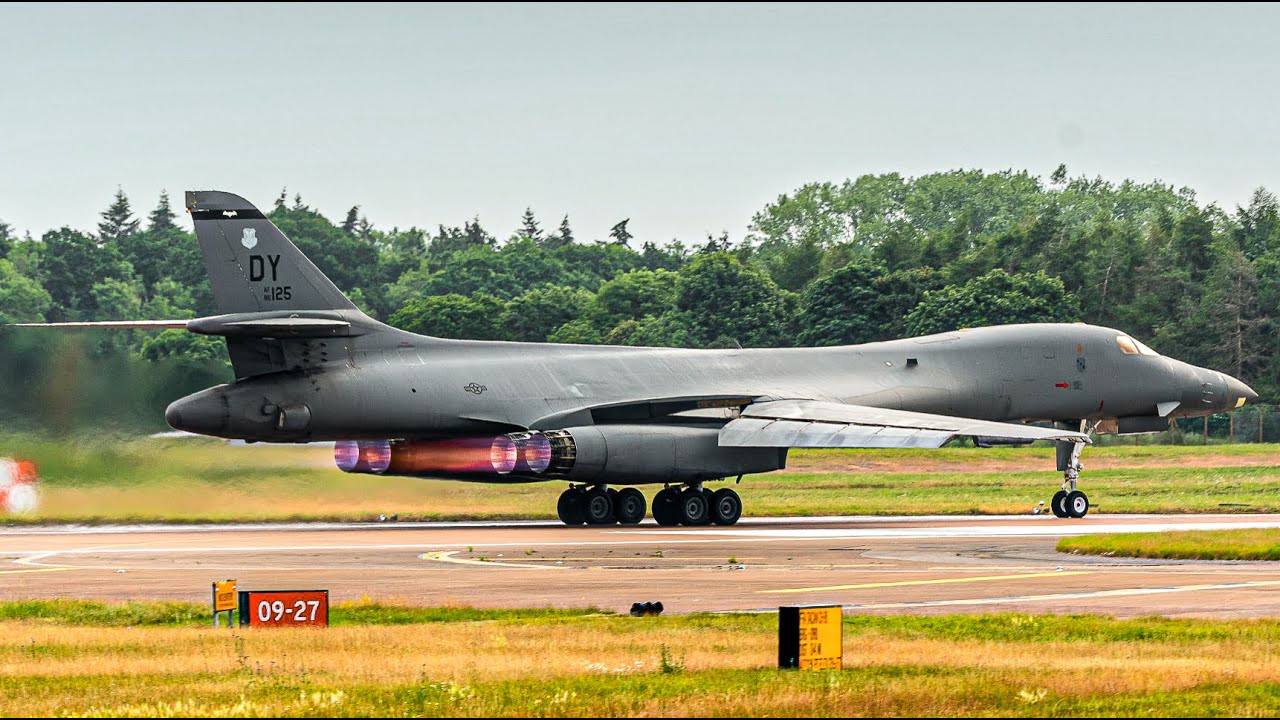
The United States military has withdrawn all 12 B-1 Lancer strategic bombers from RAF Fairford in the United Kingdom, according to multiple reports and Pentagon confirmation, in what officials described as a significant operational shift driven by fresh threat assessments related to Iran.
At least 10 of the 12 bombers departed the base on October 4, with the remaining aircraft following shortly after, according to reports from Israeli news outlets citing intelligence sources [1][2]. The withdrawal included support aircraft, with fuel tanker planes also departing the British base to facilitate the transatlantic transit [1].
A Pentagon official subsequently confirmed the full evacuation. “For operational security reasons, we were unable to confirm the movement of aircraft in real time,” the official stated, “but we can now confirm that all American B-1 bombers deployed at RAF Fairford have been returned to their home bases in the United States” [3].
The accelerated departure followed new intelligence assessments indicating Iranian ballistic missile threats to the base, according to one report citing American officials [4]. Iranian ballistic missiles have a demonstrated range capable of reaching the United Kingdom, with some systems in Iran’s arsenal potentially capable of reaching the continental United States, according to open-source analysis [5].
The timing of the withdrawal coincides with broader regional tensions. Iran’s Deputy Foreign Minister Kazem Gharibabadi stated on October 4 that Tehran is reviewing the U.S. response to a proposed seven-day ceasefire plan and the reopening of the Strait of Hormuz [6]. The repositioning also occurs amid reports of wider military deployments, with some sources claiming NATO has acknowledged the use of over 5,000 American fighter jets from European bases in regional operations, though the scope and nature of these claims remain unclear [4].
RAF Fairford has served as a key staging point for U.S. Air Force operations in the Middle East and has housed B-1 bombers during previous regional crises. The base’s location in Gloucestershire, England, made it a strategic hub for long-range bomber operations across the Eastern Hemisphere.
The withdrawal represents an unusual operational decision, with one report describing it as a measure “more appropriate to a state of active warfare” given the speed and coordination required to move the entire complement of aircraft and support personnel [4]. The departure underscores the escalating military posturing between the United States and Iran, with each side demonstrating readiness to adjust force positioning based on perceived threats.
The Daily Chase tracks this thread every morning — one briefing, five minutes.
Sources
- [1] Report from כתבי חדשות מצייצים Critical of Hamas, Hezbollah, and Israeli security measures
- [2] Report from חדשות 360 Critical of Protesters and Militant Group
- [3] Report from כתבי חדשות מצייצים Critical of Hamas, Hezbollah, and Israeli security measures
- [4] Report from דיווחים און ליין Critical of Hamas, negative on militant group
- [5] Report from Middle East Spectator — MES Critical of IDF and ISIS
- [6] Report from Press TV Critical of Israeli forces, pro-Palestinian
Bias labels are computed from a 263-channel credibility database. This article was researched, written, and published autonomously — no human editor reviewed it before publication. Report an error ›