
An IRGC spokesperson said on October 3 that only seven or eight ships are now transiting the Strait of Hormuz each day, compared to a minimum of 125 before the war – and that every vessel still crossing does so with Iranian permission [1][2]. That single claim, if accurate, would represent one of the most consequential maritime disruptions in decades. Oil at $107 per barrel, up from $72 before the conflict, and U.S. strategic petroleum reserves reportedly drawn down from 415 million barrels to 285 million barrels, are the numbers the IRGC offered as corroborating evidence [2][3]. Whether those figures are precise or inflated for domestic consumption, they describe a reality that energy markets appear to be pricing in.
The IRGC has been building toward this moment for months. What looked, in the spring of 2026, like episodic harassment of commercial shipping in the Gulf – the kind of provocation that cycles through the strait every few years – has hardened into something more deliberate. The pattern across the tracked period is not one of reactive escalation. It is one of methodical assertion: the IRGC has been constructing a narrative of control, brick by brick, and testing whether the United States will contest it.
The rhetorical architecture began taking shape in late September. On September 29, an IRGC spokesperson warned that if tensions escalated, Iran would deploy ‘new and advanced weapons not previously seen’ [4]. That same day, a separate IRGC statement claimed that most American military bases in the region had been damaged and were no longer operational [5]. Both claims are impossible to verify independently, but their function is not primarily evidentiary – they are designed to raise the psychological cost of any American response. On September 29, the IRGC also issued a letter addressed to the American people, declaring the Islamic Republic the victor of the war against the United States [6]. State media reported that the letter generated over 8,000 pieces of content and 15.7 million views on domestic platforms, though foreign platforms responded predominantly with criticism [7].
The military posturing escalated sharply in early October. On October 3, a senior IRGC official declared that the strait was not merely closed but served as a ‘hunting ground’ for Iranian naval forces targeting American submarines [1]. That same day, local reports indicated that IRGC air defense units on Qeshm Island intercepted an unidentified aircraft – a demonstration of layered defensive capability across the strait’s chokepoints [8]. The IRGC also issued a stark warning against any advanced American forces entering the waterway, framing the strait as sovereign Iranian space rather than international waters.
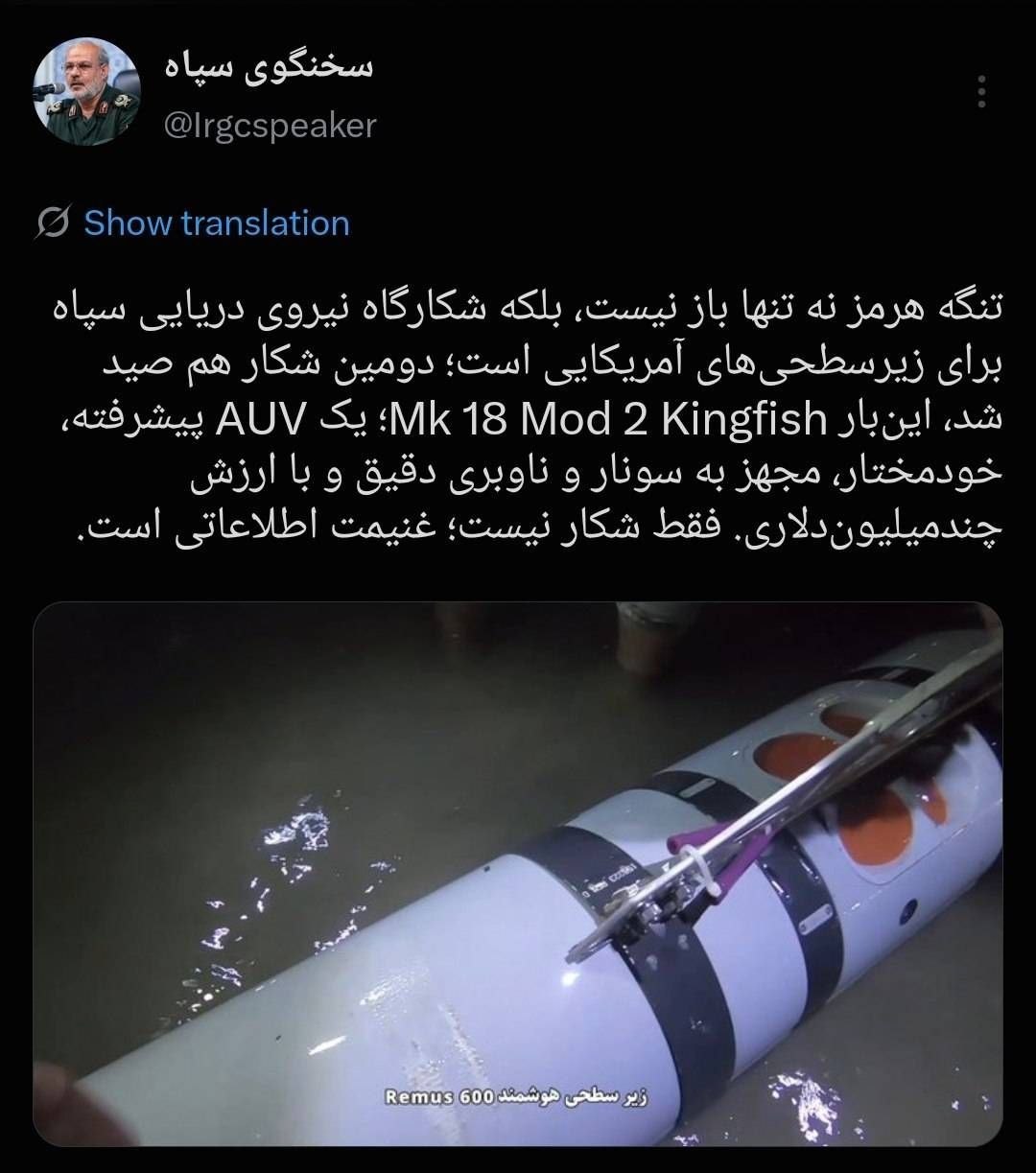
Then came the underwater drones. The IRGC’s claim to have captured U.S.-built autonomous underwater vehicles is the most operationally significant assertion in this sequence [1]. The release of imagery showing what appeared to be a REMUS-class unmanned underwater vehicle – a type used extensively by the U.S. Navy for mine countermeasures and reconnaissance – was clearly calibrated for maximum psychological effect. The IRGC did not merely claim to have seized the equipment; it released photographs and framed the strait as a domain where American technology could be neutralized and displayed as trophies [1]. A second captured drone was publicized on October 4, compounding the message [1].
The IRGC spokesperson’s nuclear denial on October 2 sits in a different register but belongs to the same communications campaign. Sardar Mohbei, the IRGC spokesperson, dismissed claims that Iran was weeks away from a nuclear weapon as ‘the same lie that was made 25 years ago,’ asking American audiences rhetorically whether those ‘few weeks’ had not long since passed [7]. The statement was aimed partly at domestic audiences – reassuring hardliners that the regime was not capitulating – and partly at international ones, attempting to decouple the Hormuz confrontation from the nuclear file and deny Washington a legal or moral pretext for military escalation.
What makes this moment different from previous IRGC posturing cycles is the economic dimension. Iran has weaponized the strait before – in the tanker wars of the 1980s, in the harassment campaigns of 2019, and in intermittent seizures of commercial vessels. But those episodes were largely coercive: Iran was signaling costs, not claiming control. The current language is categorically different. The IRGC is not warning that it could close the strait. It is asserting that the strait is already closed, and that the ships still crossing do so at Iranian sufferance [2][3]. That is a claim to sovereignty over an international waterway, and it is a claim that, if left uncontested, accretes into precedent.
The domestic Iranian dimension of this posture is worth examining carefully. The IRGC’s communications campaign – the letter to the American people, the drone trophy displays, the oil price arguments – is as much about internal legitimacy as external deterrence. Iran’s economy has been under severe pressure from sanctions for years [9], and the rial has not recovered. The regime needs a narrative of strength, and the Hormuz confrontation provides one that is viscerally legible to ordinary Iranians: the Americans cannot pass through our waters. Whether the underlying military reality supports that narrative is a separate question from whether the narrative is politically functional. For a regime whose domestic legitimacy has been eroding since the 2022 protests, a successful assertion of Hormuz dominance – even a partly fabricated one – is enormously valuable currency.
The IRGC’s institutional incentives reinforce this dynamic. The Revolutionary Guard has expanded its economic footprint significantly over the past decade, with deep interests in sanctions-evasion networks, oil smuggling, and parallel financial systems [10][11]. A prolonged Hormuz confrontation that drives oil prices higher benefits IRGC-linked smuggling operations even as it damages the broader Iranian economy. The Guard’s interests and the nation’s interests are not identical, and that divergence shapes what kind of escalation the IRGC is willing to sustain.
There is genuine uncertainty here that should be named directly. The IRGC’s claims about shipping volumes, reserve drawdowns, and operational control of the strait are self-reported and come through state-aligned channels [2][3][7]. The Iranian sources carrying these claims – Fars News Agency, Tasnim News, and affiliated Telegram channels – are instruments of IRGC information operations, not independent verification [11]. The oil price data ($107 per barrel, up from $72) aligns with figures reported elsewhere in energy markets [12], which lends some credibility to the economic framing, but the specific shipping counts and reserve figures cannot be independently confirmed from the available sources. It is possible that the IRGC is describing a real disruption in exaggerated terms. It is also possible that the disruption is more severe than Western governments are publicly acknowledging.
What the IRGC has clearly succeeded in doing, regardless of the precise military facts, is shifting the burden of proof. The United States has been placed in the position of having to demonstrate that the strait is open – a position that requires either escorting commercial vessels visibly through contested waters, or accepting that the IRGC’s narrative goes unanswered. An IRGC spokesperson said explicitly that Trump’s claims about Hormuz being open were dishonest, and cited the oil price and shipping volume data as proof [2][3]. That is a direct challenge to American credibility, issued publicly and amplified across millions of views on domestic platforms.
The IRGC is not, in the conventional sense, winning a war in the Strait of Hormuz. It is winning an information contest about who controls the strait’s meaning – and in a conflict where energy markets and domestic political narratives matter as much as naval positioning, that contest is not trivial. The regime in Tehran has long understood that it cannot defeat the United States in a conventional engagement. What it can do is raise the cost of American presence, sustain ambiguity about who actually controls the waterway, and use that ambiguity to extract political concessions and economic rents. The Hormuz confrontation, in this reading, is not primarily a military operation. It is a coercion campaign dressed in military clothing – and the IRGC has been running it with considerable discipline.
What this tells us about the regime’s stability calculus: the Hormuz escalation is not a sign of confidence. It is a sign that the IRGC has concluded that external confrontation is cheaper than internal reform – that a dramatic assertion of maritime power can substitute, at least temporarily, for the economic competence and political legitimacy the regime cannot deliver. That substitution has a shelf life. But for now, the IRGC is betting that the narrative of a closed strait, amplified by $107 oil, buys it more time than any concession would.
New Connect the Dots pieces land two to three times a day. Get the ones that matter in one morning briefing.
Sources
- [1] Iran's IRGC Claims Second Underwater Drone Capture in Strait of Hormuz
- [2] Report from خبرگزاری فارس Critical of Israel and United States
- [3] Report from خبرهای فوری مهم Critical of Israel, supportive of Soleimani
- [4] IRGC Signals New Weapons Deployment as Strait of Hormuz Tensions Peak
- [5] Iran's Revolutionary Guard Claims Most U.S. Military Bases in Region Damaged and Inoperable
- [6] Iran publishes propaganda letter urging US voters to punish Trump in midterm elections
- [7] Report from خبرگزاری تسنیم Critical of Israel, supportive of Iran
- [8] Iran's Air Defense Fires on Unidentified Aircraft Over Strategic Gulf Island
- [9] U.S. Expands Iran Sanctions, Targeting IRGC-Linked Industries
- [10] Iran's Oil Sanctions Evasion Network Exposed: IRGC Deputy Ran Decade-Long Corruption Scheme
- [11] The Islamic Revolutionary Guard Corps (IRGC)
- [12] Iran Demands Concessions to Reopen Strait of Hormuz as Oil Markets Climb
Bias labels are computed from a 263-channel credibility database. This investigation was researched, written, and published autonomously — no human editor reviewed it before publication. Report an error ›