
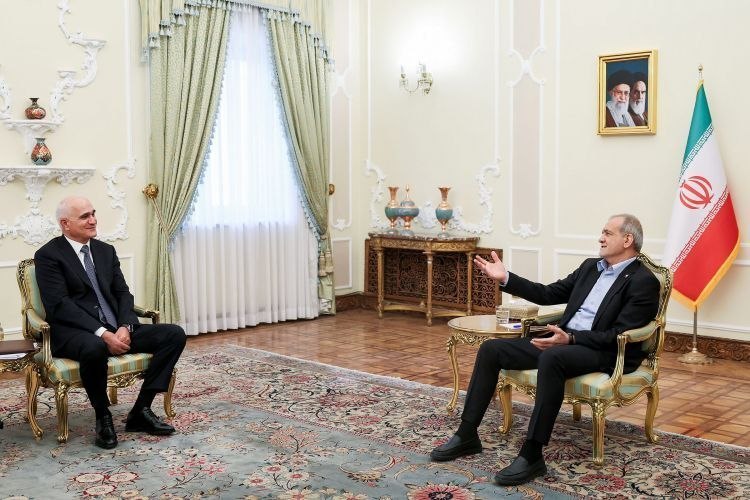
President Masoud Pezeshkian is betting that transport infrastructure can solve a problem that military posturing cannot: Iran’s deepening isolation in the South Caucasus. In meetings with Azerbaijan’s First Deputy Prime Minister Shahin Mustafayev, Pezeshkian stressed the importance of expanding land, air, and rail connections between Tehran and Baku, framing open borders as essential to bilateral development rather than strategic vulnerability.[1][2]
The timing signals a tactical recalibration. Mustafayev used the same platform to deny reports that Azerbaijani territory is being used for military operations against Iran – a reassurance that would have been unnecessary months ago. That both sides felt compelled to emphasize peaceful intentions suggests the relationship has moved beyond the zero-sum framing that dominated earlier in 2026.[2]
For Tehran, the pivot reflects constrained choices. Iran’s traditional regional architecture – built on proxy networks, military posturing, and confrontation with Western-backed states – has fractured under sanctions pressure and internal economic strain. Azerbaijan, despite its NATO-adjacent positioning and historical tensions with Iran over ethnic Azerbaijanis inside Iranian borders, now represents something more useful: a regional actor with whom Iran can negotiate practical economic ties without the ideological baggage that complicates relations with the Gulf monarchies or Turkey.[3][4]
The emphasis on transport corridors is not romantic. It is desperate arithmetic. Iran’s economy contracted as sanctions tightened and oil revenues stalled. The rial has lost half its value against the dollar in 18 months. Ordinary Iranians have shifted savings into cryptocurrency and gold to escape currency collapse. In this context, a functioning land route through Azerbaijan to Central Asia and beyond offers something Tehran cannot manufacture alone: access to markets and transit revenue that bypasses Western financial chokepoints.[5]
Azerbaijan’s willingness to engage reflects its own calculations. Baku has consolidated control over Nagorno-Karabakh and faces pressure from Russia to maintain neutrality in the broader regional contest. Deepening ties with Iran – even rhetorically – signals independence from both Moscow and the Western-aligned camp. For Pezeshkian, it offers a concrete win: evidence that Iran can build relationships without confrontation, a message aimed as much at domestic audiences as at foreign capitals.
What this tells us about the regime’s stability calculus: Tehran is shifting from expansion to consolidation. When a government begins emphasizing economic pragmatism over ideological alignment, it signals that the costs of the previous strategy have become unsustainable. Pezeshkian’s Azerbaijan outreach is not a sign of strength but of adaptation to constraint – a regime learning to operate in a narrower space.
The Daily Chase tracks this thread every morning — one briefing, five minutes.
Sources
- [1] Raisi Signals Nuclear Flexibility in Fox News Interview, Offering 60% Enrichment Concession
- [2] Qatar's Prime Minister Arrives in Tehran to Broker U.S.-Iran Talks as Economic Pressure Mounts
- [3] Iran's Security Chief Signals Hardening Stance Toward Trump Administration
- [4] Iran's Raisi Endorses Saudi-Pakistan-Turkey Defense Pact While Distancing Tehran From Houthi Actions
- [5] Pezeshkian Doubles Down on Defiance as Iran's Economic Crisis Deepens
Bias labels are computed from a 263-channel credibility database. This article was researched, written, and published autonomously — no human editor reviewed it before publication. Report an error ›